
Shipyard Welding Automation and Its Limits Below Deck
Understanding the Practical Limits of Shipyard Welding Automation
The global shipbuilding industry is relentlessly pursuing greater efficiency, and automation is at the heart of this drive. For operations leaders, the promise of robotic welding—faster cycle times, perfect consistency, and reduced labor costs—is compelling. However, the unique and complex environment of a vessel under construction presents significant challenges. Effective shipyard welding strategy is not about total automation; it is about understanding where to apply it and where the skilled human hand remains irreplaceable. This is the operational divide between the open, repetitive work on panel lines and the confined, complex tasks found below deck.
While large-scale automation transforms the assembly of flat panels and blocks, the intricate network of compartments deep within a ship's hull remains a bastion of manual and semi-automated processes. For equipment buyers and operational planners, recognizing these limitations is crucial for making smart investments in technology and personnel. As a trusted supplier to major shipbuilding markets in Brazil, Thailand, Australia, and Malaysia, we understand this nuanced reality and provide solutions tailored for every stage of vessel construction.
The Automation-Ready Zone: Panel Lines and Block Assembly
The most visible successes in shipbuilding automation are found in the pre-fabrication and assembly stages. Panel lines, where large, flat sections of the hull and superstructure are created, are ideal environments for robotic and gantry-based welding systems. This is where automation delivers its most significant return on investment.
The key factors that make these areas suitable for automation include:
- Repetitive, Predictable Welds: Panel lines involve long, straight seam and butt welds. These predictable paths are easily programmed into robotic systems, which can execute them faster and with greater consistency than any manual welder.
- Open and Accessible Workspaces: Large, flat panels laid out in a fabrication hall provide ample space for gantry systems and large robotic arms to move freely without obstruction. This accessibility is fundamental to automated workflow efficiency.
- High-Volume Throughput: The sheer volume of welding required for these large sections justifies the high capital expenditure of sophisticated automation. Processes like Submerged Arc Welding (SAW) can be employed to achieve very high deposition rates, dramatically increasing productivity.
For these high-volume automated systems to operate at peak efficiency, they require a reliable supply of high-quality consumables. A disruption in the supply of wire or flux can bring an entire production line to a halt. As an ISO 9001 certified manufacturer, we operate a 1000-square-meter facility with six production lines capable of supplying 100 tons of welding consumables per day, ensuring our partners can maintain their demanding production schedules without interruption.
The Access-Constrained Challenge: Below-Deck Welding
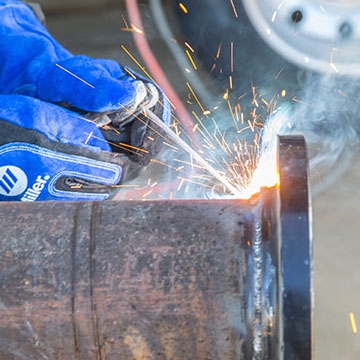
Once fabricated blocks are moved to the slipway or dry dock for erection, the nature of shipyard welding changes dramatically. The work moves from an open, factory-like setting to a complex and confined three-dimensional puzzle. Below deck, the case for full automation collapses under the weight of physical and logistical constraints.
The primary obstacles to automation in these zones include:
- Complex Geometries: Engine rooms, ballast tanks, double bottoms, and service corridors are dense with structural members, pipes, and equipment foundations. Welds are often short, interrupted, and located in corners or around curves that are impossible for a large robotic arm to reach.
- Constant Repositioning: An automated system would need to be constantly moved, recalibrated, and reprogrammed to handle the hundreds of unique, non-repetitive welds in a single compartment. The setup time would negate any potential gains in welding speed.
- Out-of-Position Welding: A significant portion of below-deck work involves vertical, horizontal, and overhead welding. While advanced robots can perform these welds, their size and the need for rigid positioning make them impractical in confined spaces. This work remains the domain of highly skilled manual welders.
- Accessibility: Simply getting a bulky robotic controller and manipulator into these tight compartments is often impossible. Spaces are designed for human access, not for machines.
These challenges highlight why the demand for skilled manual welders and versatile, portable equipment remains high in the shipbuilding industry. The final 20-30% of a ship's assembly, much of it below deck, relies almost exclusively on manual techniques to ensure structural integrity.
Bridging the Gap: Semi-Automation and Advanced Manual Processes
While full automation is impractical below deck, it does not mean that technology has no role to play. The focus shifts from replacing the welder to empowering them with advanced tools and semi-automated solutions that improve productivity, quality, and ergonomics in constrained environments.
Innovations that bridge this gap include:
- Welding Tractors: For longer, more accessible seams inside tanks or on curved hull sections, portable welding tractors can be used. These small, mechanized carriages carry the welding torch along a track or directly on the workpiece, providing the consistency of an automated process with the portability of a manual one.
- Orbital Welding Systems: In pipe-dense areas like engine rooms, orbital welding systems provide a perfect solution for high-quality, repeatable pipe-to-pipe or pipe-to-flange welds. The welding head orbits the stationary pipe, ensuring a perfect weld in any position.
- Advanced Power Sources: Modern inverter-based power sources for manual processes like Shielded Metal Arc Welding (SMAW) and Flux-Cored Arc Welding (FCAW) are lighter, more portable, and offer superior arc control. Advanced waveform technology can make out-of-position welding easier, reduce spatter, and improve overall weld quality, even in difficult conditions. A reliable arc welding machine is a critical asset for every manual welder in the yard.
The success of these processes depends heavily on the quality of the consumables used. For the demanding applications in shipyard welding, using a versatile wire like a high-quality flux-cored wire provides excellent deposition rates and all-position capability, making it a preferred choice for semi-automated and manual tasks below deck.
Selecting the Right Consumables for Varied Shipyard Environments
A successful shipyard welding operation requires a procurement strategy that matches the right consumables to the right application. The demands of an automated panel line are vastly different from those of manual welding in a double-bottom tank.
Consumables for Automated Panel Lines
For high-speed, high-volume automated welding, consistency is paramount. The primary process is Submerged Arc Welding (SAW), which requires a specific combination of wire and flux. The flux plays a critical role in shielding the arc, shaping the weld bead, and determining the mechanical properties of the finished weld. Our high-purity welding fluxes are engineered for this consistency. We use excellent raw materials like dolomite, bauxite, and silica, which are melted at 2000 °C to create a homogenous, glass-like flux that delivers stable arc performance and flawless weld quality, roll after roll.
Consumables for Manual Below-Deck Work
In contrast, consumables for manual work must be versatile and welder-friendly. Welders working in difficult positions need electrodes and wires that are easy to control and produce a high-quality weld with minimal effort.
Key products for this environment include:
- SMAW Electrodes: These are the go-to solution for repairs and welding in the most inaccessible locations. All-position electrodes like aws e6013 welding electrodes are valued for their smooth arc, easy slag removal, and reliable performance.
- Flux-Cored Wires (FCAW): Gas-shielded and self-shielded flux-cored wires offer higher productivity than SMAW while still providing the flexibility needed for out-of-position work. They are a popular choice for joining structural members and completing fillet welds throughout the ship's interior.
Partnering for Comprehensive Shipyard Welding Solutions
Optimizing a shipyard welding operation is a complex challenge that requires a hybrid approach. It involves leveraging large-scale automation where it delivers the most value—on the panel lines—while simultaneously equipping skilled manual welders with the best tools and consumables for the intricate work below deck. A successful strategy acknowledges that both approaches are not just necessary, but complementary.
As an ISO 9001 certified manufacturer with deep experience serving the global shipbuilding industry, we provide a comprehensive portfolio of welding equipment and consumables designed for every application within a shipyard. With a minimum order quantity of just 1 ton and a standard lead time of 30 days, we offer the flexibility and reliability that modern shipyards demand. From high-purity fluxes for your automated SAW stations to versatile electrodes for your manual welders, we are a single-source partner dedicated to enhancing your productivity, quality, and overall operational efficiency. Contact us to discuss how our solutions can support your unique shipbuilding challenges.