
Steel Pipe SAW: LSAW vs SSAW for Large-Diameter Lines
Optimizing Large-Diameter Lines with Steel Pipe SAW: LSAW vs. SSAW
For project engineers and procurement specialists in the pipeline industry, selecting the appropriate manufacturing method for large-diameter pipes is a critical decision that impacts project longevity, cost-efficiency, and operational integrity. Submerged Arc Welding (SAW) stands as a cornerstone technology for producing robust pipes suitable for demanding applications. Within the realm of welding materials, specifically for large diameter pipe production, two primary variants of Steel Pipe SAW dominate the market: Longitudinal Submerged Arc Welded (LSAW) pipes and Spiral Submerged Arc Welded (SSAW) pipes.
This comprehensive guide delves into the characteristics, manufacturing processes, advantages, and considerations for both LSAW and SSAW pipes, providing the insights necessary to make informed choices for your large-diameter line-pipe applications. Understanding the distinctions between these two types of SAW pipes is essential for ensuring optimal performance and cost-effectiveness in infrastructure projects worldwide, from Brazil to Australia.
Understanding Submerged Arc Welding (SAW) Technology
Submerged Arc Welding (SAW) is an arc welding process where a continuously fed consumable solid or tubular electrode is used, and a blanket of granular fusible flux covers the arc and molten weld pool. This shielding method prevents atmospheric contamination, resulting in high-quality welds. SAW is renowned for its high deposition rates, deep penetration capabilities, and excellent mechanical properties of the weld metal, making it ideal for thick sections and high-volume production, such as that found in manufacturing large diameter Steel Pipe SAW. The flux itself, a critical component in this process, uses raw materials such as excellent dolomite, bauxite, cryolite, silica, and fluorine ore, melted at 2000 °C, ensuring superior weld integrity.
The process is highly automated, which contributes to consistent weld quality and increased productivity. In pipe manufacturing, SAW is employed to create the longitudinal or spiral seam welds that join steel plates or coils into a cylindrical form. The choice between LSAW and SSAW largely depends on pipe diameter, wall thickness, material grade, and specific project requirements.
Longitudinal Submerged Arc Welded (LSAW) Pipes
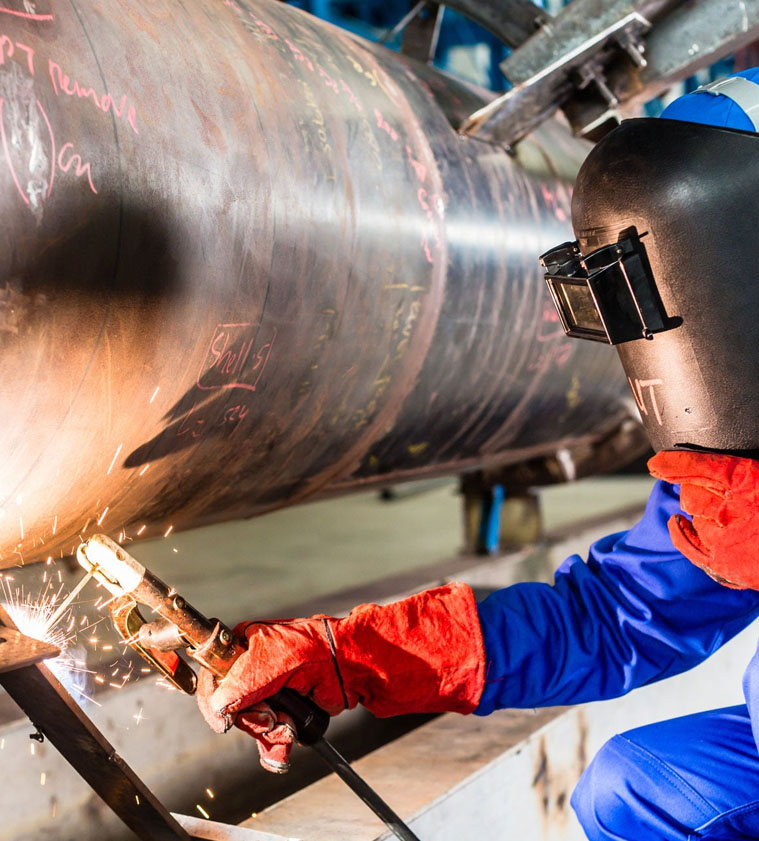
LSAW pipes are characterized by a single or double longitudinal seam weld running along the length of the pipe. These pipes are typically manufactured from single steel plates, which are first pressed into a U-shape and then an O-shape (UOE process) or formed using a JCOE (J-shape, C-shape, O-shape, Expanding) process. The edges are then welded using the SAW process.
LSAW Manufacturing Process
The manufacturing of LSAW pipes involves several precise steps:
- Plate Inspection and Preparation: High-quality steel plates are meticulously inspected for defects and cut to precise dimensions.
- Edge Milling: The plate edges are milled to create an optimal groove for welding, ensuring proper weld penetration and fusion.
- Pre-bending: The long edges of the plate are pre-bent to form the initial curvature.
- Forming (UOE/JCOE):
- UOE Process: The plate is first pressed into a U-shape, then into an O-shape using a large pressing machine.
- JCOE Process: The plate is progressively formed into a J-shape, then a C-shape, and finally an O-shape using a series of presses.
- Tack Welding: The formed O-shape pipe is tack welded to hold its cylindrical form.
- Internal and External SAW Welding: The longitudinal seam is welded from both the inside and outside using multiple SAW welding heads. This dual-pass welding ensures full penetration and superior weld integrity. Oldwelders provides advanced automatic welding machine solutions that ensure precision and efficiency in these critical steps.
- Pipe Expansion: The pipe is mechanically expanded to achieve the precise final diameter and improve dimensional accuracy and straightness. This step also helps in reducing residual stresses.
- NDE (Non-Destructive Examination): The finished pipe undergoes extensive non-destructive testing, including ultrasonic testing, radiographic testing, and magnetic particle inspection, to verify weld quality and detect any imperfections.
Advantages and Disadvantages of LSAW Pipes
Advantages:
- Superior Quality: LSAW pipes generally offer higher dimensional accuracy and better surface finish due to the precise forming and expansion processes.
- Thicker Walls and Larger Diameters: They can accommodate thicker wall thicknesses and larger diameters compared to SSAW pipes, making them ideal for high-pressure and critical applications.
- Excellent Toughness and Ductility: The UOE/JCOE process, combined with expansion, produces pipes with excellent mechanical properties, including high toughness and ductility.
- Applicability: Commonly used for oil and gas transmission lines, offshore pipelines, and structural applications where reliability is paramount.
Disadvantages:
- Higher Cost: The complex manufacturing process and specialized equipment lead to higher production costs compared to SSAW.
- Limited Plate Width: The maximum pipe diameter is limited by the width of the available steel plates.
- Lower Production Efficiency: Compared to SSAW, LSAW production rates can be slower due to the batch-wise processing of individual plates.
Spiral Submerged Arc Welded (SSAW) Pipes
SSAW pipes, also known as Helical Submerged Arc Welded pipes, are produced by spirally forming a steel coil or strip into a pipe, with the weld seam running in a helix along the pipe's length. This method allows for continuous production and can create very long pipe sections.
SSAW Manufacturing Process
The production of SSAW pipes is distinct from LSAW pipes:
- Coil Preparation: A continuous steel coil is unwound and fed into the forming machine. The edges of the coil are often trimmed and beveled.
- Spiral Forming: The steel coil is continuously fed into a forming roll system that twists and forms the strip into a spiral pipe shape. The angle of the spiral can be adjusted, which influences the pipe diameter.
- Internal and External SAW Welding: As the pipe is formed, the overlapping edges are continuously welded from both the inside and outside using the SAW process. This continuous welding is a hallmark of SSAW production. Oldwelders offers high-performance submerged arc welding flux HJ431, which is perfectly suited for such demanding continuous operations.
- Cut-off: Once the desired length is achieved, the pipe is cut off, and the process continues with the next section.
- NDE (Non-Destructive Examination): Similar to LSAW, SSAW pipes undergo thorough NDE, including ultrasonic testing of the weld seam.
Advantages and Disadvantages of SSAW Pipes
Advantages:
- Cost-Effective: The continuous production process and the ability to use narrower steel coils make SSAW pipes generally more economical to produce.
- Wide Diameter Range: SSAW pipes can be produced in a very wide range of diameters, often exceeding the practical limits of LSAW, by adjusting the forming angle.
- Longer Pipe Lengths: The continuous manufacturing process allows for the production of very long pipe sections, which can reduce the number of field welds required.
- Efficient Material Utilization: The spiral forming process can make more efficient use of steel coil material.
Disadvantages:
- Weld Seam Length: The spiral weld seam is inherently longer than a longitudinal seam for a pipe of the same length, potentially increasing the total length of weld to inspect.
- Potential for Anisotropy: The mechanical properties of SSAW pipes can sometimes exhibit anisotropy (direction-dependent properties) due to the spiral weld and forming process.
- Less Suitable for High-Pressure Applications: While improvements have been made, SSAW pipes are traditionally considered less suitable for extremely high-pressure or critical applications compared to LSAW, though modern SSAW quality is very high.
- Dimensional Tolerances: Achieving very tight dimensional tolerances can be more challenging with SSAW compared to LSAW.
Comparing LSAW and SSAW for Large-Diameter Lines
When choosing between LSAW and SSAW pipes for large-diameter lines, project specifics dictate the optimal solution. Here’s a comparative overview:
| Feature | LSAW Pipe | SSAW Pipe |
|---|---|---|
| Manufacturing Process | Batch-wise from single plates (UOE/JCOE) | Continuous from steel coils (spiral forming) |
| Weld Seam Type | Longitudinal (1 or 2 seams) | Spiral/Helical |
| Diameter Range | Typically 16" to 64"+ (limited by plate width) | Typically 20" to 120"+ (very wide range) |
| Wall Thickness | Can accommodate very thick walls (up to 100mm+) | Generally thinner walls compared to LSAW for very large diameters |
| Material Efficiency | Utilizes individual plates, some material waste from trimming | Efficient use of coils, less waste |
| Cost Effectiveness | Higher initial cost due to complex process | More economical, especially for very large diameters |
| Quality & Performance | Excellent, preferred for high-pressure, critical applications | Good, suitable for many applications, improving for critical uses |
| Production Rate | Lower due to batch processing | Higher due to continuous process |
| Applications | Oil/gas pipelines, offshore, structural, high-pressure | Water pipelines, general construction, low/medium pressure gas, pilings |
For high-pressure oil and gas transmission, especially in challenging environments, LSAW pipes are often the preferred choice due to their superior structural integrity and consistency. However, for large-diameter water pipelines, sewage systems, or structural piling, SSAW pipes offer a cost-effective and efficient solution, particularly when very long pipe sections are advantageous. The decision also hinges on the specific grade of steel requested and the environmental conditions the pipeline will endure.
Quality Assurance and Supplier Selection for Steel Pipe SAW
Regardless of whether LSAW or SSAW is chosen, robust quality assurance is paramount. A reputable supplier will adhere to stringent international standards and employ comprehensive testing protocols. Oldwelders is an ISO 9001 certified company, demonstrating our commitment to quality management systems across all our products, including welding fluxes and machinery.
Key considerations when selecting a supplier:
- Certifications and Standards: Ensure the supplier adheres to relevant industry standards (e.g., API 5L, ASTM, EN) and holds quality certifications such as ISO 9001. This indicates a commitment to consistent quality.
- Production Capacity: Evaluate the supplier's ability to meet your project's volume and timeline. Our plant, covering an area of 1000 square meters with six production lines, can supply 100 tons a day, ensuring reliable delivery for projects of varying scales.
- Quality Control Procedures: Inquire about their non-destructive testing (NDT) capabilities, material traceability, and internal quality checks throughout the manufacturing process.
- Experience and Reputation: A supplier with a proven track record in manufacturing large-diameter pipes for similar applications, serving markets like Brazil, Thailand, Australia, and Malaysia, brings invaluable expertise.
- Minimum Order Quantity (MOQ) and Lead Time: Understand the supplier's MOQ and typical lead times to ensure alignment with your project schedule. We typically offer orders from 1 ton with a lead time of 30 days.
- Technical Support: Access to knowledgeable technical support can be crucial for addressing specific project challenges or customization requirements.
Conclusion
The choice between LSAW and SSAW Steel Pipe SAW for large-diameter line-pipe applications is a nuanced one, influenced by a multitude of factors including pressure requirements, environmental conditions, pipe diameter and wall thickness, project budget, and delivery schedule. LSAW pipes offer superior performance for the most demanding, high-pressure applications where integrity is non-negotiable, while SSAW pipes provide a cost-effective and versatile solution for a broader range of applications, especially where very large diameters and long continuous pipe sections are beneficial.
By carefully evaluating the technical specifications, manufacturing processes, and the long-term operational impact of each type, project engineers and buyers can confidently select the optimal SAW pipe solution. Partnering with a trusted supplier like Oldwelders, with demonstrated manufacturing capabilities, a commitment to quality through ISO 9001 certification, and a robust supply chain, ensures that your large-diameter pipeline projects are built on a foundation of reliability and excellence.