
Match Mineral Raw Material Properties to End Uses
How to Match Mineral Raw Material Properties to Your Application
In high-stakes industrial applications like welding, the quality of the final product is directly tied to the quality of its most basic components. The performance of welding consumables, from fluxes to electrode coatings, begins with the careful selection of the right mineral raw material. Choosing an ore based on name or general classification alone is insufficient; engineers and procurement professionals must delve into specific, measurable properties to guarantee performance, consistency, and reliability in their end-use applications. Understanding how a material's physical and chemical characteristics translate into operational success is the key to optimizing production and avoiding costly failures.
At Oldwelders, we transform select ores like dolomite, bauxite, and fluorine ore into high-performance welding products. This process involves melting these materials at temperatures reaching 2000 °C to refine and homogenize them, ensuring every batch meets stringent quality standards. This foundational expertise gives us unique insight into how the properties of a base mineral dictate the final characteristics of a consumable, such as slag detachability, arc stability, and weld metal purity.
Understanding Key Physical Properties of Industrial Minerals
Physical properties are the tangible, measurable characteristics of a material that determine how it will behave during storage, handling, and processing. For applications like welding flux manufacturing, these are not minor details—they are critical performance indicators.
Melting Point and Fusion Characteristics
The melting point is the temperature at which a solid turns into a liquid. In the context of welding, the entire fusion range—from softening to full liquefaction—is crucial. A flux, for example, must melt at a temperature slightly below that of the welding wire or rod to effectively shield the molten weld pool from atmospheric contamination.
- Why it matters: If the flux melts too early, it can burn off before providing adequate protection. If it melts too late, it won't create a proper slag covering, leading to porosity and other weld defects. The viscosity of the resulting slag, also a function of its fusion characteristics, determines how well it covers the weld bead and how easily it can be removed after cooling.
Density and Bulk Density
Density refers to the mass per unit volume of the solid mineral particle, while bulk density accounts for the space between particles in a given volume (e.g., a bag or a hopper). Both are critical for logistics, equipment calibration, and final product formulation.
- Why it matters: For automated welding processes using submerged arc welding, the bulk density of a granular flux affects how it flows through feeding systems. Inconsistent bulk density can lead to uneven flux delivery, resulting in an unstable arc and inconsistent weld quality. For manufacturers, density impacts everything from shipping costs to the volume of material required for a specific formulation.
Particle Size Distribution (Granulometry)
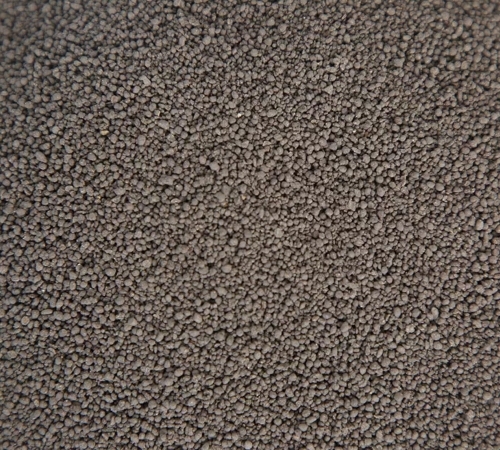
This property describes the range of particle sizes within a batch of granular material. It is often expressed as a mesh size or a distribution curve. A consistent particle size is essential for predictable behavior in manufacturing processes.
- Why it matters: In welding fluxes, particle size distribution directly influences arc stability, slag formation, and the overall appearance of the weld bead. Finer particles may melt faster but can create more dust, while overly coarse particles might not melt completely, leading to slag inclusions in the weld metal. A controlled, uniform distribution ensures reliable and repeatable welding performance.
Critical Chemical Properties and Their Impact on Performance
The chemical composition of a mineral raw material is its fundamental DNA. It dictates how the material will react under the intense heat of a welding arc and what elements it will contribute to the final weld metal and slag system.
Purity and Impurity Profile
No mineral is 100% pure. The key is to source materials where the primary compound is present at a high concentration and undesirable impurities like sulfur and phosphorus are extremely low. These impurities can be detrimental to the mechanical properties of a weld.
- Why it matters: Sulfur and phosphorus can cause hot cracking and embrittlement in steel welds, severely compromising the integrity of the joint. By sourcing and processing excellent ores like high-purity dolomite, bauxite, cryolite, silica, and fluorine ore, we control the impurity profile from the very beginning, ensuring our finished products create strong, ductile welds.
Acidity and Basicity (Basicity Index)
In welding fluxes, the ratio of basic oxides (like CaO, MgO, Na₂O) to acidic oxides (like SiO₂, TiO₂) is defined by the Basicity Index (BI). This chemical characteristic is one of the most significant factors influencing the metallurgical properties of the weld metal.
- Why it matters:
- Basic fluxes (high BI) are excellent at removing impurities like sulfur and phosphorus from the weld pool, resulting in weld metal with high toughness and excellent mechanical properties, making them suitable for critical structural applications.
- Acidic fluxes (low BI) typically offer better operational characteristics, such as a stable arc and smooth weld bead appearance, but provide less metallurgical refinement.
Key Elemental Contributions
Different minerals are selected for the specific, beneficial elements they contribute to the welding process.
- Fluorine (from Fluorine Ore/Fluorspar): Helps stabilize the welding arc and reduces the viscosity of the slag, improving its coverage and detachability.
- Silicon and Manganese (from Silica and other ores): Act as deoxidizers, reacting with oxygen in the weld pool to prevent porosity and form a manageable slag.
- Aluminum (from Bauxite): A powerful deoxidizer that also helps refine the grain structure of the weld metal, improving its toughness.
From Raw Material to High-Performance Welding Consumables
The journey from a raw mineral to a finished product like a welding fluxes is a carefully controlled manufacturing process. It requires not only sourcing the right materials but also possessing the infrastructure and quality systems to process them consistently. At Oldwelders, our entire operation is designed around this principle.
Our ISO 9001 certification is a testament to our commitment to quality management at every stage. This process begins with rigorous inspection and testing of incoming raw materials to verify their physical and chemical properties. From there, our 1000-square-meter plant, equipped with six modern production lines, enables a high degree of process control. This facility has the capacity to supply 100 tons of finished product per day, ensuring we can meet the large-volume demands of our industrial clients in markets like Brazil, Thailand, Australia, and Malaysia with consistent quality and reliability.
By managing the entire production chain—from crushing and melting the mineral raw material to sizing and packaging the final flux—we ensure that every bag of product, such as our popular submerged arc welding flux hj431, performs exactly as specified. This vertical integration allows us to deliver a product where the properties are not just theoretical but are proven and repeatable.
A Practical Workflow for Selecting Your Materials
For engineers and procurement managers, navigating the complexities of material selection can be challenging. Following a structured workflow can simplify the process and lead to better outcomes.
- Define Application Requirements: Start with the end in mind. What are the non-negotiable requirements for the weld? This includes mechanical properties (tensile strength, impact toughness), welding position (flat, vertical), and operational needs (slag removal, bead appearance).
- Identify Key Material Properties: Translate your application requirements into material properties. If high impact toughness at low temperatures is required, you will likely need a basic flux with very low levels of sulfur and phosphorus. If ease of use on-site is the priority, an acidic or rutile-based material might be more appropriate.
- Review Supplier Specifications and Certifications: Request detailed technical data sheets (TDS) and material safety data sheets (MSDS) from potential suppliers. Scrutinize the chemical composition, particle size distribution, and other stated properties. Verify their quality certifications, such as ISO 9001, which indicates a robust quality management system.
- Request Samples and Test Reports: A data sheet is a promise; a sample is a proof of concept. Obtain a representative sample of the material for in-house evaluation. Ask for batch-specific test reports (certificates of analysis) to see the supplier's consistency over time.
- Conduct Testing and Validation: The final step is to test the material in your specific application, under your real-world conditions. This is the only way to confirm that the selected mineral raw material will deliver the desired performance and a reliable result every time.
Partnering with an Experienced Supplier
Selecting the right industrial minerals is as much about choosing the right partner as it is about choosing the right material. An experienced supplier does more than just sell a product; they provide technical expertise, transparent documentation, and a reliable supply chain. They understand how variations in mineral properties affect your final product and can provide the consistency needed for high-quality manufacturing.
At Oldwelders, we leverage our deep expertise in material science and welding technology to help our clients make informed decisions. We offer practical business terms, including a minimum order quantity (MOQ) of 1 ton and a standard lead time of 30 days, making it straightforward for you to plan your procurement and production schedules. Whether you are sourcing base materials for your own consumable production or seeking finished products, our team is ready to provide the high-quality welding materials and support you need to succeed.