
How to Verify Steel Pipe SAW Suppliers Before Ordering
How to Verify Steel Pipe SAW Suppliers Before Ordering
For Engineering, Procurement, and Construction (EPC) firms and large-scale importers, the procurement of submerged arc welded pipe is a critical undertaking with significant financial and safety implications. These large-diameter pipes form the backbone of major infrastructure projects, from oil and gas pipelines to structural foundations. However, the global marketplace is complex, and distinguishing a qualified, vertically integrated pipe mill from a third-party trader can be challenging. This guide provides a clear framework for verifying suppliers of Steel Pipe SAW, ensuring you partner with a manufacturer that can deliver on quality, compliance, and schedule.
Placing a substantial order based on a compelling price alone, without thorough due diligence, exposes a project to unacceptable risks. These include inconsistent quality, fraudulent documentation, production delays, and a complete lack of traceability. A genuine manufacturer has direct control over every stage of production, from raw material sourcing to the final welding process, while a trader does not. Your verification process must be designed to uncover this fundamental difference.
The Critical Difference: Mill vs. Trader
Understanding the distinction between a pipe mill and a trading company is the first step in mitigating procurement risk. While both can supply pipe, their capabilities, responsibilities, and the value they provide are vastly different.
A pipe mill is a manufacturing facility that transforms raw materials—typically hot-rolled steel coils or plates—into finished pipes. They operate the forming presses, manage the welding lines, conduct non-destructive testing (NDT), and perform finishing processes like coating and end-bevelling. A true mill possesses deep technical expertise and has direct control over the quality of the final product.
A trader or stockist, on the other hand, is an intermediary. They purchase pipes from one or more mills and resell them. While traders can offer value through logistics, financing, or by consolidating smaller orders, they do not manufacture the product. When you buy from a trader, you are one step removed from the production process. This can lead to:
- Lack of Control: You have no direct influence over the production schedule, quality control parameters, or the selection of raw materials and consumables.
- Traceability Issues: It can be more difficult to get clear, verifiable documentation tracing the product back to its source heat of steel and the specific welding consumables used.
- Limited Technical Support: A trader may not have the in-house engineering expertise to resolve complex technical queries about welding procedures or material specifications.
- Higher Costs: The final price includes the trader's margin, which may or may not be offset by the services they provide.
For critical applications, partnering directly with a qualified mill is almost always the preferred approach for ensuring transparency and quality assurance.
Essential Documentation to Request from Potential Suppliers
Paperwork is the first line of defense in supplier verification. A reputable manufacturer will readily provide comprehensive documentation to prove their capabilities and compliance. Be wary of any supplier who is hesitant or unable to produce the following:
1. Business License and Scope
Request an official, translated copy of the company's business license. Scrutinize the "scope of business" section. It should explicitly state "manufacturing" or "production" of steel pipes. If the scope is limited to "trading," "import/export," or "wholesale," you are likely dealing with an intermediary.
2. Quality Management System (QMS) Certification
A valid ISO 9001 certificate is the minimum standard for a credible manufacturer. It demonstrates that the supplier has established and maintains a formal quality management system. At Oldwelders, for example, our own ISO 9001 certification underpins every aspect of our operations, from raw material intake to final product inspection. Ask for the certificate and verify its authenticity with the issuing body.
3. Mill Test Certificates (MTCs)
Ask for sample MTCs (also known as Mill Test Reports or MTRs) from recent, similar projects. A proper MTC, typically to EN 10204 3.1 or 3.2 standards, provides complete traceability. It details the chemical composition and mechanical properties of the steel, linking it back to a specific heat number. It should also include information on the welding consumables used. Scrutinize these documents to ensure they are issued by the company you are vetting, not a third-party mill.
4. Welding Procedure Specification (WPS) and Procedure Qualification Record (PQR)
The WPS is the "recipe" for the weld, detailing all essential variables like voltage, amperage, travel speed, and the specific welding materials to be used. The PQR is the proof that this recipe works, providing the test results from a sample weld. Any legitimate SAW pipe mill will have a library of pre-qualified WPS/PQR documents for various materials and thicknesses.
Evaluating the Heart of Production: The Welding Process
The integrity of a submerged arc welded pipe weld seam is paramount. This is where the quality of the supplier's equipment and consumables truly comes to light. A thorough audit should extend to their welding operations.
The submerged arc welding process relies on a granular flux to shield the arc, shape the weld bead, and influence the final metallurgical properties. The quality and consistency of this flux, along with the welding wire, are non-negotiable for producing sound welds that meet international standards. When vetting a supplier, ask detailed questions:
- What brands and specifications of welding wire and flux do they use?
- How do they store and handle their consumables to prevent moisture absorption?
- What quality control checks do they perform on incoming welding fluxes and wires?
A world-class pipe mill understands that superior output requires superior input. This is the core principle behind our own manufacturing. Our 1000 square meter plant, equipped with six production lines, can produce up to 100 tons of high-purity flux per day. We achieve this by using only excellent raw materials like dolomite, bauxite, and cryolite, which are melted at 2000°C to ensure unparalleled chemical purity and consistency. This commitment to quality in consumables is what you should look for in your pipe mill's own philosophy.
Beyond Paperwork: Signs of a Reputable Supplier
While documentation is crucial, it's only part of the picture. A truly reliable partner exhibits several other key characteristics.
Technical Expertise and Transparency
Engage the supplier's technical team in a detailed conversation. Can they confidently discuss the nuances of their welding processes? Can they explain how they would adjust parameters for specific project requirements? A manufacturer will have engineers on staff who can answer these questions; a trader will likely have to defer to their source mill. Furthermore, a transparent supplier will provide clear commercial terms. For instance, we operate with a standard 30-day lead time and a minimum order quantity of 1 ton, providing our partners with predictable and reliable service.
Proven Global Experience
A track record of successfully exporting to regulated and demanding markets is a powerful trust signal. It indicates that the supplier is familiar with international standards, complex logistics, and diverse client expectations. Experience in markets like Brazil, Thailand, Australia, and Malaysia demonstrates a supplier's ability to navigate different customs regimes and meet stringent regional specifications, proving they are a reliable global partner.
Manufacturing Capacity and Equipment
Ask for a detailed equipment list and inquire about their production capacity. A genuine mill can provide specifics on the number of production lines, their diameter and thickness ranges, and their annual tonnage output. Cross-reference this with their stated lead times to see if they align. Be skeptical of any supplier who claims near-infinite capacity or impossibly short lead times.
The Critical Role of Consumables in Final Pipe Quality
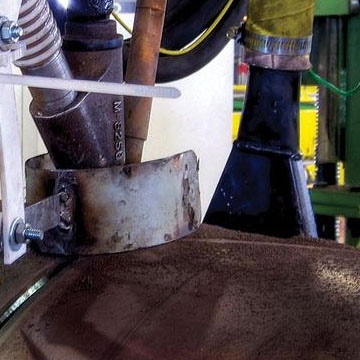
Ultimately, the long-term performance of any submerged arc welded product depends on the quality of the weld itself. This is determined by the synergy between the welding machine, the operator's skill, and the consumables used. As a buyer, you must insist on knowing what goes into the weld seam.
The welding flux, in particular, plays a multifaceted role:
- Shielding: It creates a protective layer of molten slag and gas to prevent atmospheric contamination of the weld pool.
- Alloying: The flux can be formulated to add or compensate for specific alloying elements, refining the final chemical composition of the weld metal.
- Weld Shaping: It influences the viscosity and surface tension of the molten slag, which shapes the final weld bead profile.
- Mechanical Properties: The cooling rate, controlled by the slag, and the chemical reactions within the flux directly impact the toughness and strength of the finished weld.
A pipe mill that compromises on consumable quality is compromising on the structural integrity of its product. When auditing a supplier, don't just accept "we use good quality flux." Ask for the specific type, such as a high-performance fused flux like our submerged arc welding flux hj431, and request the data sheets to verify its properties.
Conclusion: A Partnership Built on Verification
Verifying a submerged arc welded pipe supplier is an investment in your project's success and safety. By moving beyond surface-level price comparisons and implementing a rigorous verification process, you can confidently distinguish between a true manufacturing partner and an intermediary. Demand comprehensive documentation, probe their technical expertise, and pay close attention to the quality of their welding process and consumables.
While Oldwelders is not a pipe manufacturer, we are experts in the materials that guarantee the strength and reliability of every weld. We partner with leading fabricators and mills worldwide to ensure their welding operations are built on a foundation of quality. Contact us to learn how our high-performance welding consumables and deep process expertise can elevate the quality standards for your next critical project.