
How to Source Steel Structure SAW Without RFQ Mix-Ups
How to Source Steel Structure SAW Equipment Without RFQ Mix-Ups
As a fabrication buyer or member of an export procurement team, you face the daily challenge of translating technical requirements into precise purchase orders. An ambiguous request for a "Steel Structure SAW" can bring your sourcing process to a halt. Does your engineering team need a cutting tool like a band saw, or are they referring to a specialized welding process? This single point of confusion can lead to incorrect quotes, project delays, and significant sourcing headaches. Understanding the correct industrial meaning of this term is the first step toward a streamlined and accurate procurement cycle.
In the world of heavy fabrication, "SAW" almost always refers to Submerged Arc Welding, a high-productivity process essential for joining the thick plates used in buildings, bridges, and pressure vessels. This guide will clarify the ambiguity, detail what Submerged Arc Welding entails, and provide a clear framework for building a technical RFQ that gets you accurate quotes from qualified suppliers the first time.
Decoding the "SAW" Acronym in Heavy Fabrication
While a "saw" is universally known as a cutting tool, the acronym "SAW" holds a different, specific meaning within the welding and metal fabrication industry. When procurement requests involve creating, not cutting, large steel assemblies, SAW stands for Submerged Arc Welding. This distinction is critical for sourcing professionals.
Why the potential for confusion? Both processes are fundamental to steel structure fabrication. Raw steel plates and beams must first be cut to size before they can be assembled and welded. However, the equipment, consumables, and technical expertise for cutting are entirely different from those for welding. Sending an RFQ for a "saw" to a welding supplier, or vice versa, results in wasted time for both parties.
Submerged Arc Welding earned its place as a primary method for heavy steel because of its unique advantages:
- High Deposition Rates: SAW systems can deposit large amounts of weld metal quickly, significantly faster than manual or semi-automatic processes. This speed is crucial for meeting deadlines on large-scale construction projects.
- Deep Weld Penetration: The process generates a powerful, stable arc that penetrates deep into the base material, creating strong, solid welds in a single pass on thick sections.
- Exceptional Weld Quality: Because the arc is "submerged" under a blanket of granular flux, the molten weld pool is completely protected from atmospheric contamination. This results in clean, uniform welds with excellent mechanical properties and minimal spatter.
- Automation-Friendly: The process is easily automated using tractors, manipulators, or column and boom systems, ensuring consistent quality over long weld seams, such as those on I-beams or large pipes.
Recognizing that a request for equipment for a **Steel Structure SAW** project is a request for a welding solution is the key to unlocking an efficient sourcing process.
What is Submerged Arc Welding and Why is it Essential for Steel Structures?
Submerged Arc Welding is a wire-fed arc welding process where the arc is not visible. Instead of a shielding gas, a layer of granular, fusible material called flux is used. Here’s a step-by-step breakdown of how it functions:
- Flux Application: A hopper releases a continuous layer of flux onto the joint, completely covering the area to be welded.
- Arc Initiation: A continuously fed consumable wire electrode is fed through the flux layer to make contact with the workpiece, initiating a powerful electric arc.
- The "Submerged" Arc: The arc melts the tip of the wire electrode and the adjacent base metal. The heat also melts the bottom layer of the flux, creating a molten slag. This arc and molten metal are completely submerged under the flux blanket, isolating the process from the air.
- Weld Formation: The molten slag protects and refines the molten weld pool. As the welding head moves along the joint, the molten metal solidifies to form the weld bead. The molten slag floats to the surface and solidifies behind the weld pool.
- Slag Removal: Once cooled, the protective slag layer is easily chipped away, revealing a clean, smooth, and high-integrity weld. Unused flux can often be collected and reused.
The quality of the flux is paramount to the success of this process. It dictates the chemical composition and mechanical properties of the final weld. At Oldwelders, we control this critical variable from the source. Our flux products are produced in a 1000-square-meter facility where raw materials like high-grade dolomite, bauxite, and silica are melted at 2000°C. This rigorous process ensures the purity and consistency required for demanding structural applications.
Key Specifications for Your Submerged Arc Welding RFQ
To avoid mix-ups and receive comparable quotes, your RFQ must be specific. A well-defined request demonstrates technical understanding and allows suppliers to propose the most effective and economical solution. Here are the core components to include when sourcing a system for **Steel Structure SAW**.
1. Welding Power Source
The engine of the system, the power source, dictates the welding output. Specify the required amperage and duty cycle. For heavy plate, power sources are typically in the 600-1500 amp range. You also need to define the type of current:
- Direct Current (DC): Offers a stable arc and smooth bead profile, excellent for most applications.
- Alternating Current (AC): Often used in multi-wire setups to prevent arc blow, a magnetic phenomenon that can deflect the arc.
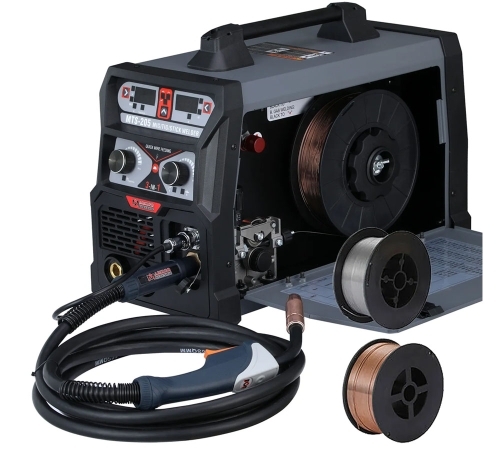
A complete welding machine for SAW will often include the power source, controller, and wire feeding mechanism in an integrated package.
2. Welding Head and Automation
Describe how the welding head will be moved along the joint. Is this for a fixed production line or for mobile work on large fabrications?
- Welding Tractor: A self-propelled, portable carriage that travels along the workpiece. Ideal for long, straight seams on ship decks, bridge girders, or large tanks.
- Column and Boom Manipulator: A stationary setup with a vertical column and a horizontal boom that holds the welding head. It provides stable, repeatable motion for welding cylindrical or rotating parts.
- Wire Configuration: Specify if a single-wire, tandem (two-wire), or multi-wire setup is needed. Multi-wire systems dramatically increase deposition rates for very thick materials.
3. Welding Consumables: Wire and Flux
This is the most critical part of your RFQ. The combination of wire and flux determines the final mechanical properties of the weld (strength, toughness, etc.). You must specify both.
- Welding Wire: Provide the AWS (American Welding Society) classification (e.g., EM12K, EH14) and the required diameter (e.g., 3.2mm, 4.0mm). This ensures the filler metal matches the strength of the base steel. We offer a comprehensive range of solid wire options for various structural steels.
- Welding Flux: Provide the AWS classification (e.g., F7A2, F7A4). The "F" indicates flux, the "7" indicates the minimum tensile strength (70,000 psi), the "A" indicates "as-welded" condition, and the final number ("2" or "4") indicates the minimum impact toughness temperature. Also, specify the flux type (fused or agglomerated). As a manufacturer with a capacity of 100 tons per day, we can ensure a reliable supply of high-quality welding fluxes for even the largest projects.
Common Applications and Quality Assurance
The Submerged Arc Welding process is the backbone of several key industries due to its reliability and efficiency. Understanding these applications helps in selecting the right consumables and ensuring quality.
Fabrication of Structural Beams
The automated production of I-beams and H-beams is a classic application. A SAW system, often a gantry or manipulator, welds the flange to the web in long, continuous passes. The high speed and consistency are unmatched by other processes.
Bridge and Heavy Construction
For bridge girders, box sections, and other massive components, SAW is the only practical choice. The welds must meet stringent code requirements for strength and fatigue resistance. This is where a supplier's quality management system becomes crucial. Oldwelders is an ISO 9001 certified company, providing the documented quality assurance necessary for critical infrastructure projects.
Pressure Vessels and Pipelines
Welding the longitudinal and circumferential seams on thick-walled pressure vessels and large-diameter pipes requires the deep penetration and flawless weld quality that SAW provides. The process ensures leak-proof, high-strength joints capable of withstanding high pressure and temperature.
Partnering with a Reliable Supplier for Your Welding Needs
Eliminating RFQ mix-ups is about more than just using the right acronym; it's about building a clear, technical specification that communicates your project's needs. By defining the power source, automation method, and, most importantly, the specific wire and flux combination, you empower your suppliers to provide accurate and competitive quotes.
At Oldwelders, we are more than just a component supplier. We provide complete welding solutions, from the automatic welding machine to the precisely formulated consumables that ensure the integrity of your final product. With experience serving clients in markets from Brazil and Thailand to Australia and Malaysia, we understand the logistical and technical demands of global procurement. Our standard 30-day lead time and manageable 1-ton minimum order quantity for consumables allow you to plan your projects effectively.
The next time a request for a **Steel Structure SAW** system lands on your desk, you can approach it with confidence. By clarifying that the need is for Submerged Arc Welding, you can move forward efficiently, secure in the knowledge that you are sourcing the right solution for your company's most demanding fabrication challenges.