
How to Choose Rutile Welding Rods for All-Position Welds?
Selecting the Right Rutile Welding Rod for All-Position Applications
In the world of manual metal arc welding (MMAW), the choice of electrode is critical to achieving sound, efficient, and aesthetically pleasing welds. For general-purpose fabrication and repair work on mild steel, the rutile welding rod is a ubiquitous consumable, valued for its user-friendly characteristics. However, not all rutile electrodes are created equal, especially when the demands of a project require welding in various positions—flat, horizontal, vertical, and overhead. Selecting the correct rod for all-position capability requires a deeper understanding of its coating, operational characteristics, and the specific demands of each welding orientation.
This guide provides fabrication supervisors and maintenance welders with a practical framework for choosing the right consumable. It moves beyond basic classifications to explore the nuances that differentiate a standard downhand rod from a true all-position performer, ensuring you can maintain productivity and quality, regardless of the joint's orientation.
Understanding Rutile Coatings and Their Impact on Weldability
The performance of any shielded metal arc welding (SMAW) electrode is largely determined by its flux coating. In the case of rutile electrodes, the primary component is titanium dioxide (TiO2) in its rutile mineral form. This key ingredient is responsible for the attractive features that have made these rods a workshop staple worldwide.
The primary functions of the rutile-based flux include:
- Arc Stabilization: Rutile is an excellent arc stabilizer, promoting a smooth, consistent, and quiet arc. This makes it easier for welders of all skill levels to maintain control, reducing the likelihood of defects like porosity or irregular bead shape.
- Slag Formation: Upon melting, the flux forms a protective slag layer over the molten weld pool. Rutile slags are typically fluid and provide excellent coverage, shielding the hot metal from atmospheric contamination (oxygen and nitrogen) that could cause embrittlement and porosity. This slag is also often self-detaching or easily removed, minimizing post-weld cleaning time.
- Weld Bead Profile: The properties of the rutile slag help shape the weld bead, typically resulting in a smooth, finely-rippled surface with a convex profile. This aesthetic finish is highly desirable in many applications where appearance is important.
- Deoxidation: The coating contains deoxidizers, such as ferromanganese and ferrosilicon, which react with oxygen in the weld pool to form oxides that are then absorbed into the slag. This process purifies the weld metal, improving its mechanical properties.
At Oldwelders, the quality of our welding consumables is rooted in the purity of our raw materials. Our process begins with excellent dolomite, bauxite, cryolite, and silica, which are meticulously processed and melted at 2000 °C to create the high-performance fluxes used in our electrodes. This foundational quality control ensures every rod delivers the consistent arc stability and slag control you depend on.
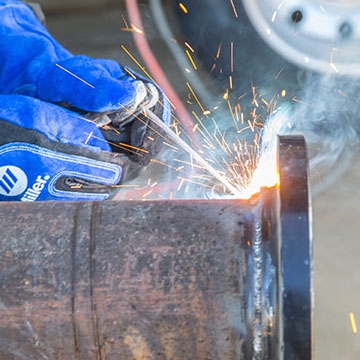
Key Characteristics for All-Position Welding Performance
While most rutile electrodes perform exceptionally well in the flat (1G/1F) and horizontal (2G/2F) positions, their suitability for vertical and overhead work depends on specific modifications to the flux coating. When selecting a rod for all-position capability, you must evaluate the following characteristics.
Slag Viscosity and Freezing Rate
This is arguably the most critical factor for out-of-position welding. A standard rutile electrode produces a highly fluid slag, which is advantageous for downhand welding as it flows easily to cover the bead. However, in vertical or overhead positions, this same fluidity becomes a liability. Gravity will cause the molten slag to run, making it difficult to control the weld pool and potentially trapping slag within the weld.
An all-position rutile welding rod is formulated with additions to the flux that make the slag more viscous and faster-freezing. This "stickier" slag solidifies quickly, creating a small shelf that helps hold the molten metal in place against the force of gravity. When reviewing a product datasheet, look for terms like "fast-freezing slag" or "viscous slag" as indicators of its out-of-position capability.
Arc Force and Penetration Profile
The arc force, or the intensity of the plasma jet, influences penetration. General-purpose rutile electrodes typically have a soft, low-penetration arc. This is ideal for sheet metal or bridging wide gaps but can be insufficient for achieving proper fusion in thicker materials, especially in vertical-up or overhead positions. All-position rods often have a slightly more forceful, focused arc to ensure adequate penetration at the root of the joint without being as aggressive as a cellulosic electrode (e.g., E6010).
Iron Powder Content
Many rutile electrodes contain iron powder in the flux coating. When the rod is consumed, this iron powder is transferred across the arc and becomes part of the deposited weld metal. This increases the deposition rate (the amount of metal deposited per unit of time) and improves efficiency.
However, rods with very high iron powder content (e.g., over 30%) are typically suitable only for flat and horizontal positions. The increased volume of molten metal is too difficult to control in vertical or overhead orientations. All-position electrodes usually have a low to moderate iron powder content, balancing good deposition rates with a manageable weld pool size. For a versatile option, look for classifications like AWS E6013, which is a classic example of a welding materials choice for general-purpose, all-position work.
A Practical Selection Framework for Different Welding Positions
To choose the right consumable, you must match the electrode's characteristics to the specific demands of each welding position. Here is a job-facing breakdown:
Flat (1G, 1F) and Horizontal (2G, 2F) Positions
For downhand welding, you have the most flexibility. Gravity works in your favor, helping to shape the bead and control the slag. In these positions, you can prioritize efficiency and deposition rate. A rutile electrode with a higher iron powder content is an excellent choice for long, continuous welds on flat plates or horizontal fillet welds. The fluid slag will cover the weld pool effectively, and the high deposition rate will increase productivity.
Vertical-Up (3G, 3F) Position
Welding vertically against gravity is challenging. The key is to control the weld pool and prevent it from sagging or rolling out. For this, you need an electrode with a fast-freezing, viscous slag. The welder will typically use a weaving or whipping technique to deposit a series of small, overlapping shelves of weld metal. The slag must solidify quickly enough to support each subsequent deposit. A standard, fluid-slag rutile rod will not work here. You must specifically select an all-position E6013 or a similar classification designed for vertical-up progression.
Vertical-Down (3G, 3F) Position
Vertical-down welding is a high-speed technique often used on sheet metal or for sealing passes where penetration is not the primary concern. This position requires an electrode that can be "dragged" quickly down the joint. The arc must be stable, and the slag must not run ahead of the weld pool and cause inclusions. A soft-arc rutile electrode is often suitable for this, provided the slag is manageable. This technique is less common for structural work due to its characteristically lower penetration.
Overhead (4G, 4F) Position
This is the most difficult position. The welder must fight gravity directly to deposit metal into the joint. The weld pool must be kept small and under control at all times. The electrode must have a fast-freezing, high-viscosity slag that solidifies almost instantly to hold the molten metal in place. The arc must be steady and focused. Only a true all-position aws e6013 welding electrodes or a similar designated rod is suitable for overhead work. Attempting to use a standard downhand rod will result in poor bead profile, slag inclusions, and a high risk of weld failure.
Matching the Electrode to Your Base Material and Application
The vast majority of rutile electrodes are designed for welding low-carbon or mild steels. Their chemical composition and mechanical properties are formulated to match these common structural materials. They are an excellent choice for a wide range of applications, including:
- General structural steel fabrication
- Repair and maintenance work
- Welding of pipes and tanks
- Shipbuilding and repair
- Fabrication of agricultural equipment
When selecting your electrode, always check that its specified tensile strength and other mechanical properties meet the requirements of your base material and the engineering specifications for the project. For most general-purpose work, an electrode with a tensile strength of 60,000 psi (as indicated by the "60" in E6013) is sufficient.
The choice of power source is also a factor. Most rutile electrodes are designed to run on both AC and DC currents. DC with electrode negative (DCEN) produces lower penetration, while DC with electrode positive (DCEP) provides deeper penetration. AC falls in between. The flexibility to use any polarity makes these rods compatible with a wide range of power sources, from simple transformer-based units to modern inverter welding machine models.
Ensure Quality and Supply Chain Reliability
Finally, the performance of even the best-specified electrode can be compromised by poor manufacturing quality or improper storage. Inconsistent flux coatings, moisture absorption, and batch-to-batch variations can lead to arc instability, porosity, and other costly defects.
Partnering with a reliable supplier is essential for consistent results. At Oldwelders, our manufacturing processes are ISO 9001 certified, ensuring that every product we produce adheres to the highest international quality standards. With a 1000-square-meter plant and six production lines capable of supplying 100 tons per day, we have the capacity to serve large-scale industrial needs and maintain a stable supply chain for our partners in demanding markets like Thailand, Malaysia, and Brazil.
By understanding the critical interplay between flux composition, slag control, and welding position, you can confidently select the right rutile welding rod for any job. This ensures not only the integrity and quality of your welds but also the efficiency and productivity of your entire welding operation.