
Hardfacing Electrode: The 5-Year Overlay Cost Formula
The 5-Year Overlay Cost Formula for Your Hardfacing Electrode Selection
For plant managers and procurement teams, the battle against wear and tear on critical machinery is relentless. Abrasion, impact, and corrosion constantly threaten the operational lifespan of expensive components, leading to costly downtime and replacements. Surface engineering through hardfacing—the application of a wear-resistant welded overlay—is a proven strategy to combat this degradation. However, justifying the upfront investment requires more than just comparing the price per kilogram of a consumable. It demands a forward-looking financial analysis.
This article provides a comprehensive 5-year Total Cost of Ownership (TCO) formula specifically for hardfacing applications. By using this framework, you can accurately assess the long-term financial benefits, justify budget allocations, and make data-driven decisions when selecting a supplier for your wear protection needs.
Understanding the True Cost of Component Wear
Before diving into the formula, it's crucial to appreciate the full spectrum of costs associated with component failure. The direct cost of a replacement part is often just the tip of the iceberg. The true financial impact includes a cascade of secondary and tertiary expenses that can dwarf the initial material cost.
- Lost Production: Every hour a critical piece of equipment is offline for repair is an hour of lost revenue. For high-throughput operations in mining, agriculture, or manufacturing, this can amount to tens of thousands of dollars per day.
- Labor Costs: The expense isn't limited to the welder's time. It encompasses the entire maintenance crew involved in disassembly, component removal, installation, and re-assembly. Overtime pay is common in emergency repair scenarios.
- Associated Damage: When one component fails, it can cause collateral damage to adjacent parts, escalating a simple repair into a major overhaul.
- Inventory Costs: To mitigate unplanned downtime, companies often hold a large inventory of spare parts, which ties up capital and requires storage space and management resources.
- Safety Risks: Worn or failing components can create unsafe operating conditions, increasing the risk of accidents and associated liabilities.
Hardfacing directly addresses these issues by extending the service life of parts, allowing for planned maintenance cycles and drastically reducing the frequency of unplanned, costly failures.
The 5-Year Total Cost of Ownership (TCO) Formula for Hardfacing
To accurately evaluate the investment, we use a TCO formula that balances the initial and ongoing costs against the quantifiable savings over a five-year period. This long-term view is essential for appreciating the full value proposition of a quality hardfacing program.
The core formula is:
5-Year TCO = (Initial Application Cost) + (Total Reapplication Costs) - (Total Cost Savings)
A positive result indicates a net cost, while a negative result signifies a net saving, or a positive return on investment. Let's break down each component in detail.
Component 1: Initial Application Cost (IAC)
This is the total upfront cost to apply the first protective overlay to the component.
IAC = (Consumable Cost) + (Labor Cost) + (Operational Cost)
- Consumable Cost: This is the price of the welding consumables required. It's not just the price per kilogram but also the deposition efficiency. A higher-efficiency electrode deposits more weld metal and less slag, meaning you buy less material to achieve the same overlay thickness. When evaluating suppliers, consider their range of welding materials to find the optimal product for your application.
- Labor Cost: Calculated as (Welder's Hourly Rate) x (Total Hours). The time required includes surface preparation (cleaning, grinding), preheating, welding, and post-weld finishing. An electrode with a smooth arc and high deposition rate can significantly reduce total welding time.
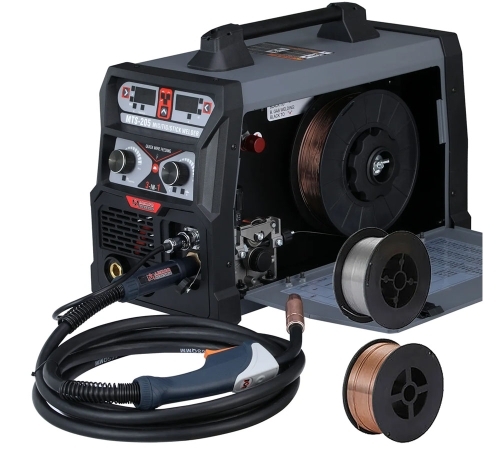
- Operational Cost: This includes the electricity consumed by the welding power source, shielding gases (if any), and the amortized cost of the equipment, such as a robust arc welding machine capable of handling demanding duty cycles.
Component 2: Total Reapplication Costs (TRC)
Over five years, the hardfaced layer will eventually wear down and require reapplication. The quality of the initial overlay directly determines how often this is needed.
TRC = (Cost per Reapplication) x (Number of Reapplications in 5 Years)
- Cost per Reapplication: This is calculated similarly to the IAC, but may be lower if the base metal requires less preparation.
- Number of Reapplications: This is the most critical variable. A superior hardfacing deposit with the correct alloy composition for the specific wear mechanism (e.g., high-chromium for abrasion, manganese for impact) might last two or three times longer than a generic, lower-cost alternative. This dramatically reduces the TRC over the 5-year period.
Component 3: Total Cost Savings (TCS)
This is where the return on investment is realized. These are the costs you avoid by implementing a hardfacing strategy.
TCS = (Avoided Replacement Part Costs) + (Value of Increased Uptime)
- Avoided Replacement Part Costs: Calculate the cost of the OEM or aftermarket replacement part multiplied by the number of times it would have been replaced in five years without hardfacing. For a component that typically lasts six months, you would avoid nine replacements over a five-year span.
- Value of Increased Uptime: This is the financial benefit of keeping the machinery in operation. Calculated as (Hours of Downtime Avoided) x (Revenue per Hour of Operation). Extending a component's life from six months to two years through hardfacing eliminates three lengthy replacement procedures, translating directly to the bottom line.
How Electrode Selection Critically Impacts the Formula
The TCO formula makes it clear that the cheapest hardfacing consumable is rarely the most cost-effective. The quality, consistency, and suitability of the electrode are the primary drivers of long-term value. This is where partnering with a knowledgeable and reliable manufacturer becomes a strategic advantage.
Quality and Consistency: A manufacturer with rigorous quality control, such as ISO 9001 certification, ensures that every batch of electrodes performs predictably. As an ISO 9001 certified company, Oldwelders guarantees this consistency, which is vital for planning maintenance schedules. Predictable wear rates mean you can confidently forecast when reapplication will be needed, eliminating guesswork and preventing unexpected failures. Inconsistent quality leads to variable service life, undermining the entire premise of a planned maintenance program.
Alloy Composition: There is no one-size-fits-all solution for wear. A chromium carbide overlay excels in high-abrasion, low-impact environments like screw conveyors, while a manganese steel deposit is ideal for high-impact conditions found in rock crushers. Selecting the wrong type of hardfacing electrode can lead to premature failure of the overlay. A capable supplier offers a wide range of alloys and the technical expertise to help you match the right product to your specific wear environment.
Deposition Rate and Efficiency: As noted in the IAC calculation, electrodes that deposit more metal faster directly reduce labor costs, which are often the largest component of the total expense. This is especially true for large-scale applications or automated processes that may use specialized products like submerged arc welding flux hj431 in conjunction with wire. An investment in a slightly more expensive but more efficient consumable can yield significant savings on the total project cost.
Partnering for Long-Term Reliability and Value
Successfully implementing a cost-saving hardfacing program requires more than just a product; it requires a partnership with a supplier who can provide consistent quality, technical support, and supply chain reliability. For procurement teams in demanding markets from Brazil to Australia, supply chain stability is paramount.
At Oldwelders, our 1000-square-meter facility with six production lines has a capacity of 100 tons per day, ensuring we can meet demanding project timelines and large-volume orders. With a standard minimum order quantity of 1 ton and a lead time of 30 days, we provide the predictability that industrial operations depend on. Our process, which involves melting premium raw materials like bauxite and dolomite at 2000 °C, results in high-purity, high-performance welding consumables you can trust.
By using the 5-Year TCO formula, you can shift the conversation from short-term price to long-term value. This data-driven approach allows you to demonstrate the significant return on investment that a high-quality hardfacing electrode provides, protecting your critical assets and boosting your company's bottom line.