
What Is a Welding Electrode? A Guide to Parts and Functions
Understanding the Essential Parts and Functions of a Welding Electrode
In the world of Shielded Metal Arc Welding (SMAW), few components are as fundamental as the consumable stick, or welding electrode. This seemingly simple rod is a highly engineered tool that performs multiple critical tasks simultaneously to create a sound and durable weld. For procurement managers, engineers, and technicians, understanding its construction is the first step toward selecting the right consumable for your application, ensuring both operational efficiency and structural integrity. A high-quality welding electrode is the cornerstone of a successful SMAW project.
At its core, the electrode serves two primary purposes: it conducts the electrical current to create the arc, and it melts to provide the filler metal that joins the base materials. However, its sophisticated design, particularly the flux coating, enables a series of complex chemical and physical reactions that are essential for producing a clean, strong, and defect-free weld. This article will deconstruct the anatomy of an electrode, exploring each part and its specific function in the welding process.
The Core Components of a Welding Electrode
Every stick electrode consists of two main parts: a solid metal core wire and a bonded outer coating of flux. While they work in unison, each has a distinct and vital role. The interplay between these two components defines the electrode's performance characteristics, from arc stability to the mechanical properties of the finished weld.
The Core Wire: The Conductor and Filler Metal
The core wire, or core rod, is the metal center of the electrode. Its primary function is to conduct the welding current from the electrode holder down to the workpiece. As the arc is established, the intense heat melts the tip of the core wire, which is then transferred across the arc in tiny droplets to become the filler metal in the weld joint.
The composition of the core wire is a critical factor, as it largely determines the chemical makeup of the deposited weld metal. It is typically made from high-quality, "rimmed" or killed steel and must match or be compatible with the base metal being welded. Common core wire materials include:
- Mild Steel: Used for general-purpose electrodes for welding carbon steels.
- Low-Alloy Steel: Contains additional elements like chromium, molybdenum, or nickel to increase strength and toughness, suitable for high-strength applications.
- Stainless Steel: Used for welding various grades of stainless steel, providing corrosion resistance.
- Non-Ferrous Metals: Such as aluminum, nickel alloys, and copper alloys for specific applications.
The diameter of the core wire dictates the appropriate amperage range for the electrode and influences the deposition rate—the amount of metal deposited per unit of time. A larger diameter requires a higher current and deposits more metal, making it suitable for thicker materials.
The Flux Coating: The Protective Shield and Performance Enhancer
The flux coating is a carefully formulated mixture of minerals, metal powders, and chemical compounds bonded to the core wire. This coating is far more than just a protective layer; it is the "brain" of the electrode, orchestrating the entire welding process. When subjected to the heat of the arc, the flux decomposes and reacts to perform several functions simultaneously. As a company dedicated to quality, Oldwelders produces its flux products from excellent raw materials like dolomite, bauxite, and silica, melted at 2000 °C to ensure purity and performance. This commitment extends to the coatings on all our welding consumables.
Unpacking the Critical Functions of the Flux Coating
The true complexity and ingenuity of a modern welding electrode lie within its flux coating. This chemical sheath is responsible for everything from arc stability to the final metallurgical properties of the weld. Understanding these functions helps explain why different electrodes behave differently and are suited for specific tasks.
Arc Stabilization and Ionization
One of the primary roles of the flux is to stabilize the electric arc. The coating contains arc-stabilizing elements, such as potassium and sodium compounds. When heated, these elements readily ionize (release electrons), creating a conductive path for the welding current to flow smoothly and consistently across the gap between the electrode and the workpiece. A stable arc results in less spatter, easier control for the welder, and a more uniform weld bead.
Shielding Gas Generation
As the flux coating burns in the arc, it decomposes and releases a cloud of inert or active gases, such as carbon dioxide and carbon monoxide. This gas cloud forms a protective shield around the molten weld pool, displacing the surrounding atmospheric gases like oxygen and nitrogen. Without this shield, these atmospheric contaminants would react with the molten metal, leading to porosity, embrittlement, and ultimately, a weak and failed weld.
Slag Formation for Protection and Shaping
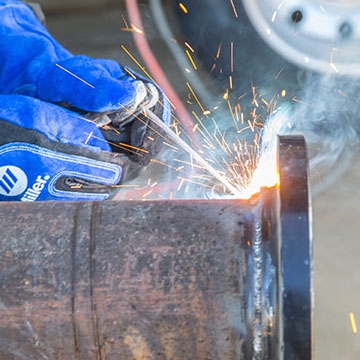
After the flux melts, it forms a liquid layer of "slag" that floats on top of the molten weld pool. This slag has several jobs:
- Protection: It provides a secondary shield against atmospheric contamination as the weld begins to cool.
- Insulation: It insulates the hot weld bead, slowing the cooling rate. This is crucial for preventing a brittle microstructure from forming, especially in higher-strength steels.
- Bead Shaping: The slag's viscosity and surface tension help hold the molten metal in place and shape the final contour of the weld bead. This is particularly important for welding in vertical or overhead positions.
- Cleaning: The slag can also absorb impurities from the molten weld pool, effectively cleaning the weld metal as it solidifies.
Once the weld cools, the hardened slag can be easily chipped or brushed away, revealing the clean metal underneath.
Deoxidation and Alloying
The flux coating often contains deoxidizers, such as manganese and silicon. These elements have a strong affinity for oxygen and will combine with any oxygen present in the weld pool to form oxides that are then absorbed into the slag. This deoxidation process is vital for preventing porosity and ensuring a dense, solid weld.
Furthermore, the coating can be used to introduce specific alloying elements into the weld metal. Metal powders like chromium, nickel, or molybdenum can be included in the flux to enhance the final weld's mechanical properties, such as tensile strength, impact toughness, or corrosion resistance, beyond what the core wire alone could provide.
How Electrode Classification Systems Work (AWS)
To standardize performance, organizations like the American Welding Society (AWS) have established a classification system. For carbon steel electrodes, this is typically a four or five-digit number prefixed by an "E," such as E6013 or E7018.
Here's a basic breakdown:
- E: Signifies it is an electrode for arc welding.
- First Two Digits (e.g., 60, 70): Indicate the minimum tensile strength of the deposited weld metal in thousands of pounds per square inch (ksi). For example, an E7018 produces a weld with a minimum tensile strength of 70,000 psi.
- Third Digit (e.g., 1, 2, 4): Represents the recommended welding position. '1' is for all positions (flat, horizontal, vertical, overhead), '2' is for flat and horizontal positions, and '4' is for flat, horizontal, overhead, and vertical down.
- Fourth Digit (e.g., 3, 8): This number indicates the type of flux coating, the usable polarity (AC, DC+, or DC-), and other operating characteristics. For example, the '8' in E7018 signifies a low-hydrogen, iron powder coating.
Understanding this system allows you to quickly identify the capabilities of a given welding electrode and match it to your project's specific requirements. For instance, our popular AWS E6013 welding electrodes are known for their all-position capability and smooth arc, making them a versatile choice for many applications.
Choosing the Right Electrode for Your Application
Selecting the correct welding electrode is not a one-size-fits-all decision. The optimal choice depends on a thorough analysis of the application's demands. Key factors to consider include:
- Base Metal Properties: The electrode's filler metal must be compatible with the base metal's composition to ensure a strong metallurgical bond.
- Required Mechanical Properties: The project may specify minimum requirements for tensile strength, ductility, and impact toughness, which will guide your selection (e.g., E70xx vs. E60xx).
- Welding Position: The job may require welding in vertical or overhead positions, necessitating an electrode designed for out-of-position work (e.g., those with a '1' as the third digit).
- Power Source: Check whether your welding machine provides AC, DC+, DC-, or a combination, and choose an electrode compatible with your available output.
- Joint Design and Fit-Up: Some electrodes offer deeper penetration for tight-fit joints, while others are better at bridging wide gaps.
As a global supplier with experience in markets like Brazil, Thailand, and Australia, we understand the diverse standards and environmental conditions our clients face. Our technical team can help you navigate these factors to find the ideal electrode for your needs.
Partnering with a Reliable Consumables Supplier
The performance of a welding electrode is directly tied to the quality of its manufacturing. Inconsistent flux density, improper moisture content, or impurities in the core wire can all lead to poor weld quality, costly rework, and potential safety hazards. That is why partnering with a supplier committed to stringent quality control is paramount.
At Oldwelders, our operations are governed by an **ISO 9001** certified quality management system, ensuring that every product we deliver meets the highest standards of consistency and reliability. Our state-of-the-art, 1000-square-meter plant is equipped with six production lines capable of supplying up to 100 tons of consumables per day. This capacity, combined with our minimum order quantity of just 1 ton and a typical lead time of 30 days, allows us to serve both large-scale industrial projects and smaller businesses with equal dedication.
From the core wire to the final flux coating, every component is engineered for performance. By understanding the intricate functions of a welding electrode, you can make more informed purchasing decisions and ensure the success of your critical welding operations. Explore our full range of welding materials to find the right solution for your next project.