Selecting the Right Welding Rod for Rusty Steel Applications
Selecting the Right Welding Rod for Rusty Steel Applications
Welding rusty steel presents a unique challenge for maintenance contractors and export buyers alike. The presence of rust, scale, and other contaminants can severely compromise weld quality, leading to costly failures and rework. Choosing the correct
electrode is paramount for achieving strong, reliable joints when working with aged steel assets. This guide delves into the complexities of welding rusty surfaces, identifies the specific types of welding rod that offer some tolerance for contaminants, and outlines the critical surface preparation necessary to ensure optimal results. At Oldwelders, we understand the demands of real-world applications and provide professional, knowledgeable guidance to help you qualify application limits before comparing suitable product grades.
Understanding Rust and Its Impact on Welds
Rust is essentially hydrated iron oxide, formed when iron or steel reacts with oxygen and moisture. It’s a porous, flaky material that can vary in thickness and adhesion to the base metal. When welding rusty steel, several detrimental effects can occur:
- Porosity: The most common issue. Moisture trapped within the rust turns into steam, and oxygen from the oxides can react with molten metal to form gases that become trapped in the solidifying weld pool, creating voids.
- Lack of Fusion: Rust acts as a barrier between the electrode and the base metal, preventing proper wetting and fusion, leading to weak spots.
- Increased Spatter: Contaminants can cause an erratic arc, leading to excessive spatter and an untidy weld bead.
- Reduced Mechanical Properties: Welds made on rusty steel often exhibit lower tensile strength, yield strength, and ductility compared to welds on clean material.
- Arc Instability: The arc may wander or extinguish, making it difficult to maintain a consistent weld.
The critical balance lies in understanding when a specific welding rod can compensate for minor surface contamination and when thorough cleaning becomes an absolute necessity. While some electrodes are designed to tolerate certain levels of rust, none can fully overcome heavily corroded or layered rust without significant compromise to weld integrity.
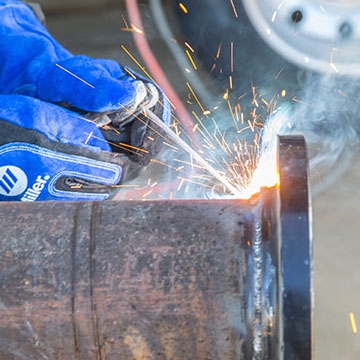
Electrodes Designed for Contaminated Surfaces
While no electrode can magically turn heavily rusted steel into pristine material, certain types of welding rod offer characteristics that help mitigate the negative effects of minor surface contamination. These electrodes typically possess strong arc forces, deeper penetration, or specialized flux formulations that can help burn through or float out impurities.
Cellulosic Welding Rods (E6010, E6011)
Cellulosic electrodes, such as AWS E6010 and E6011, are often the first choice for field repairs on less-than-ideal surfaces, including rusty or painted steel.
- Deep Penetration: They produce a very strong, digging arc that penetrates deeply into the base metal, helping to burn through light rust and impurities.
- Strong Arc Force: The forceful arc helps to expel contaminants from the weld pool.
- High Volume of Shielding Gas: The cellulose in the flux decomposes to produce a large volume of hydrogen-rich shielding gas, which can help to protect the molten pool from atmospheric contamination and moisture in the rust.
- Fast Freezing Slag: Their slag is thin and freezes quickly, making them suitable for all-position welding and helping to trap impurities that are floated to the surface.
E6010 is typically used with DC+ (reverse polarity) and is favored for its deep penetration and ability to handle gaps. E6011 is designed for AC and DC+, offering similar characteristics but with greater versatility for different power sources. Both are excellent for structural welding, pipeline repairs, and general fabrication where surface conditions might not be perfect. However, they produce more spatter and a coarser bead appearance compared to other types.
Rutile Welding Rods (E6013)
The
AWS E6013 welding electrodes are known for their user-friendliness, smooth arc, and aesthetically pleasing bead appearance. While not as tolerant of heavy rust as cellulosic types, they can handle light rust and mill scale better than low-hydrogen electrodes.
- Smooth Arc: Provides a stable, quiet arc that is easy to strike and maintain.
- Good Bead Appearance: Produces a smooth, fine-rippled bead with minimal spatter.
- Versatility: Can be used with AC or DC- (straight polarity) and is suitable for all positions.
- Slag Control: The slag is typically easy to remove.
E6013 electrodes are often used for general fabrication, light structural work, and sheet metal applications where appearance is important and surface contamination is minimal. For anything more than very light rust, pre-cleaning is highly recommended to prevent porosity and ensure adequate fusion.
Low Hydrogen Welding Rods (E7018)
Low hydrogen electrodes, such as E7018, are prized for producing welds with excellent mechanical properties, high ductility, and resistance to cracking, especially in high-strength steels. However, their tolerance for rust is generally very low.
- Superior Mechanical Properties: High strength and toughness, ideal for critical applications.
- Cracking Resistance: Minimizes hydrogen-induced cracking, crucial for certain alloys.
- Requires Clean Surfaces: To achieve their optimal performance and reduce the risk of porosity and hydrogen pick-up, E7018 electrodes demand very clean, dry surfaces. Even light rust can significantly degrade weld quality.
While not a primary choice for welding *through* rust, E7018 electrodes are essential for structural integrity once the base metal has been thoroughly cleaned. If you are repairing a critical component with rusty steel, the process should involve meticulous surface preparation followed by welding with a high-quality low-hydrogen electrode from a trusted supplier like Oldwelders.
Flux-Cored Welding Wires
While not technically a solid welding rod, flux-cored wires (FCAW) deserve mention due to their ability to handle moderately contaminated surfaces, particularly self-shielded versions (
flux-cored wire).
- Deep Penetration: Similar to cellulosic electrodes, flux-cored wires generally offer good penetration.
- Arc Stability with Contaminants: The flux within the wire helps to deoxidize the weld pool and stabilize the arc, making them somewhat tolerant of mill scale and light rust.
- High Deposition Rates: They are excellent for fast, high-volume welding.
- Self-Shielded (FCAW-S): These wires do not require external shielding gas, making them highly portable and effective in outdoor or windy conditions, where surface contaminants might also be present.
For applications involving moderately rusty steel, especially in outdoor environments or where gas shielding is impractical, self-shielded flux-cored wires can be a viable alternative to solid electrodes.
Essential Surface Preparation for Optimal Results
Regardless of the welding rod selected, proper surface preparation is the single most critical factor in achieving a high-quality weld on rusty steel. Relying solely on the electrode's ability to "burn through" contaminants is a compromise that often leads to substandard results and potential failures.
When dealing with more than very light, tightly adhering rust, or any form of loose, flaky rust, thorough cleaning is indispensable. The goal is always to achieve a bright, metallic surface in the weld zone.
Methods of Rust Removal:
- Grinding: Angle grinders with abrasive discs or wire wheels are highly effective for removing thick, loose rust, paint, and scale. This is often the most practical method for field repairs.
- Wire Brushing: Power wire brushes can remove lighter rust and surface contaminants, providing a cleaner surface.
- Sandblasting/Abrasive Blasting: For larger areas or heavily corroded parts, abrasive blasting provides the most thorough cleaning, leaving a pristine surface ready for welding.
- Chemical Rust Removers: While effective, these require careful handling, proper ventilation, and thorough rinsing to ensure no chemical residue remains to contaminate the weld.
Always ensure that the prepared surface is dry and free of any oil, grease, paint, or other foreign materials before welding. Even seemingly minor contaminants can cause significant issues during the welding process.
Choosing the Right Welding Rod for Your Project
Selecting the optimal welding rod involves a careful assessment of several factors beyond just the presence of rust:
- Severity of Rust: Light surface rust vs. heavy, flaky corrosion.
- Type of Steel: Mild steel, low-alloy steel, high-strength steel.
- Desired Weld Properties: Strength, ductility, impact toughness for critical applications.
- Welder Skill Level: Some electrodes are more forgiving than others.
- Welding Position: All-position capabilities might be required.
- Available Equipment: AC or DC power sources, availability of shielding gas.
- Environmental Conditions: Outdoor vs. indoor, presence of wind.
For critical applications or where there's uncertainty, it's always advisable to consult with welding engineers or product specialists. At Oldwelders, we pride ourselves on being an ISO 9001 certified manufacturer, ensuring that our entire range of
welding materials meets stringent quality standards. Our expert team can provide tailored recommendations based on your specific project requirements, helping you navigate the complexities of welding rusty steel. We maintain a professional, knowledgeable B2B tone in all our interactions, ensuring you receive the best advice and products.
Partnering with Oldwelders for Reliable Welding Solutions
Oldwelders is a trusted global supplier of comprehensive welding solutions, including high-quality welding machines, welding wires, welding rods, and welding fluxes. Our commitment to excellence is reflected in our robust manufacturing capabilities. The Oldwelders plant covers an impressive area of 1000 square meters and is equipped with six advanced production lines, capable of supplying up to 100 tons of flux products daily. We meticulously source excellent raw materials such as dolomite, bauxite, cryolite, silica, and fluorine ore for our flux products, which are then melted at an intense 2000 °C to ensure superior performance.
We understand the need for reliable supply and efficient logistics. With a minimum order quantity (MOQ) of just 1 ton for many of our products and a typical lead time of 30 days, we are well-positioned to support both small and large-scale projects. Our extensive experience serves diverse markets, including Brazil, Thailand, Australia, and Malaysia, demonstrating our global reach and understanding of varied industry demands.
Whether you require a specific welding rod for challenging rusty steel applications or a complete suite of welding solutions, Oldwelders is your reliable partner. We combine deep technical knowledge with a steadfast commitment to quality and customer service, ensuring you receive products that perform consistently, even under demanding conditions. Contact us today to discuss your welding needs and discover how our expertise can benefit your operations.
