
Understanding the Metal Melting Process for Industry
Understanding the Fundamentals of the Metal Melting Process
The transformation of solid metal into a liquid state is a cornerstone of modern civilization. From the casting of massive structural components to the microscopic weld pool that joins two pieces of steel, a controlled melting process is fundamental to nearly every aspect of metal fabrication and manufacturing. For professionals in foundries, fabrication shops, and material production facilities, a deep understanding of this physical transformation is not merely academic—it is essential for ensuring quality, efficiency, and safety. This comprehensive guide explores the science, stages, technologies, and critical control factors that define the industrial conversion of metal from solid to liquid.
Mastering this transformation is crucial for producing everything from raw ingots to high-performance consumables. The integrity of the final product, whether it's a structural beam or a specialized welding wire, is determined by the precision applied during its molten phase. A flawed melt can introduce impurities, create structural weaknesses, and lead to costly failures down the line. Conversely, a well-managed operation yields materials with predictable, reliable, and superior performance characteristics, a principle that drives manufacturing for demanding markets from Brazil to Australia.
The Science Behind Metal Liquefaction
At its core, melting is a phase transition. In a solid metal, atoms are arranged in a fixed, crystalline lattice structure, vibrating in place but held together by strong metallic bonds. To initiate melting, energy—typically in the form of heat—must be introduced into the system. This added energy increases the kinetic energy of the atoms, causing them to vibrate more violently.
As the temperature rises, the vibrations become so intense that they overcome the metallic bonds holding the atoms in their rigid positions. The ordered crystal structure breaks down, and the atoms are free to move past one another. This is the point at which the metal transitions into a liquid state. The specific temperature at which this occurs is known as the melting point.
An important concept in this transition is the "latent heat of fusion." This is the amount of additional energy required to complete the phase change from solid to liquid *after* the material has already reached its melting point. During this phase, even though heat is continuously being added, the temperature of the substance does not rise until all the solid has been converted to liquid. This energy is consumed to break the remaining crystalline bonds. Understanding this principle is vital for calculating the total energy required for industrial-scale operations and ensuring a complete and uniform melt.
Key Stages in an Industrial Melt Operation
While the physics is universal, the industrial application of melting is a multi-stage, systematic operation designed for scale and repeatability. Each stage presents unique challenges and requires precise control to achieve the desired outcome.
1. Charging and Raw Material Preparation
The process begins with charging—the loading of raw materials into the furnace. The quality of the final product is directly tied to the quality of the inputs. Raw materials can include recycled scrap, primary ore, refined ingots, and alloying elements. These materials must be clean, free of contaminants like oil, moisture, and excessive rust, and sorted by composition. At Oldwelders, the production of our high-quality welding fluxes begins with sourcing excellent raw materials, such as dolomite, bauxite, cryolite, and silica, which form the basis for a stable and effective final product.
2. Melting
Once the furnace is charged, energy is applied to raise the temperature of the charge to its melting point and beyond. The goal is to achieve a fully liquid, homogenous bath. The method of heating varies significantly based on the furnace technology used, from the intense electrical arcs in a steel mill to the electromagnetic fields in an induction furnace. The key is to apply energy efficiently and to ensure the entire bath reaches the target "superheat" temperature—a temperature slightly above the melting point to ensure fluidity for subsequent steps.
3. Refining and Alloying
Simply melting the metal is rarely sufficient. In its molten state, the metal is refined to remove impurities and adjust its chemical composition. This can involve several techniques:
- Degassing: Bubbling inert gases like argon through the melt to remove dissolved gases such as hydrogen, which can cause porosity in the final casting.
- Slag Treatment: Introducing fluxes that float on the surface of the melt. These fluxes react with and trap impurities (like sulfur and phosphorus), forming a slag layer that can be skimmed off.
- Alloying: Precise amounts of other elements (e.g., carbon, chromium, manganese) are added to the molten bath to create an alloy with specific mechanical properties, such as increased strength, corrosion resistance, or hardness.
4. Tapping and Pouring
After the molten metal has reached the correct temperature and chemical specification, it is tapped (drained) from the furnace into a ladle. The ladle is a refractory-lined vessel used to transport the liquid metal to the next stage, which could be casting into molds (for discrete parts), continuous casting (for slabs and billets), or atomization (for producing metal powders). This transfer must be done quickly and smoothly to minimize heat loss and prevent re-oxidation from atmospheric exposure.
Common Technologies and Furnaces Used
The choice of furnace is dictated by the type of metal, the required production volume, and the desired level of purity and control. Each technology leverages a different principle to generate the immense heat needed for the melting process.
Electric Arc Furnace (EAF)
EAFs are the workhorses of the steel industry, particularly for recycling scrap. They use high-power graphite electrodes to create a powerful electric arc between the electrodes and the metal charge. This arc generates intense heat, with temperatures reaching thousands of degrees Celsius, rapidly melting the scrap. EAFs offer fast melting times and are more flexible than traditional blast furnaces.
Induction Furnace
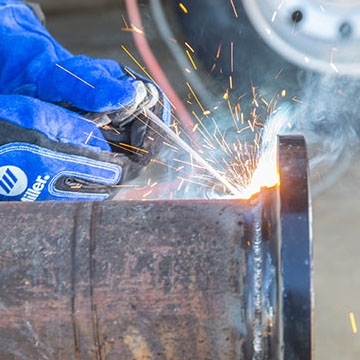
Induction furnaces use electromagnetic induction to heat the metal. An alternating current is passed through a coil surrounding the crucible containing the metal charge. This creates a powerful magnetic field, which in turn induces eddy currents within the metal itself. The resistance of the metal to the flow of these currents generates heat very rapidly and efficiently. This method is exceptionally clean as there is no direct contact between the heating element and the material, making it ideal for producing high-purity alloys and specialty steels. The principles of controlled heating are also essential in equipment like an arc welding machine, which creates a miniature, localized melt pool.
Crucible Furnace
These are simpler furnaces where the metal is held in a refractory pot, or crucible, which is heated externally by gas or electricity. They are typically used for smaller batches and for non-ferrous metals like aluminum, brass, and bronze. Their relatively low cost and simple operation make them common in smaller foundries and workshops.
Factors Influencing a Successful Melting Process
Achieving a consistent, high-quality melt requires vigilant control over several key variables. Any deviation can impact the chemical and mechanical properties of the final product.
Raw Material Purity: As mentioned, the quality of the input materials is paramount. For critical applications like manufacturing premium welding consumables, starting with pure, certified raw materials is non-negotiable. Our own production of submerged arc welding flux hj431 relies on a meticulously controlled melting process where high-grade ores are melted at 2000 °C to ensure maximum purity and performance.
Temperature Control: Precise temperature management is critical. Underheating can result in an incomplete melt or poor fluidity, while overheating wastes significant energy and can burn off valuable alloying elements or damage the furnace lining. Modern furnaces are equipped with advanced thermocouples and pyrometers for real-time monitoring.
Atmospheric Control: Molten metals are highly reactive with oxygen in the air, leading to the formation of oxides that can become trapped as inclusions, weakening the final product. To prevent this, operations may be conducted in a vacuum or an inert gas atmosphere. More commonly, a layer of flux or slag is used to shield the surface of the melt from the air.
Process Consistency: Repeatability is the hallmark of a professional operation. Every step, from the charging weight to the holding time and tapping temperature, must be documented and standardized. This ensures that every batch of material meets the same exacting specifications.
Safety and Quality Assurance in Melting Operations
Working with tons of liquid metal at extreme temperatures presents significant safety risks. A robust safety culture is essential, encompassing extensive personal protective equipment (PPE), rigorous training on handling molten materials, and well-designed ventilation systems to manage fumes and heat. The risk of steam explosions from contact with moisture is a constant and serious hazard that requires strict protocols for handling all tools and materials.
Quality assurance is equally important. At Oldwelders, our operations are governed by an ISO 9001 certified quality management system. This framework ensures that every stage of our production is monitored and verified. With a plant covering 1000 square meters and six production lines capable of supplying 100 tons per day, this level of process control is vital for meeting the demands of our international clients. From initial material inspection to final product testing, this commitment to quality ensures we can consistently deliver on our 30-day lead times with a minimum order quantity of 1 ton.
The metal melting process is a sophisticated blend of physics, chemistry, and engineering. By understanding its fundamental principles and controlling its many variables, manufacturers can transform basic raw materials into the high-performance products that build our world. This foundational knowledge is the first step toward optimizing any operation that relies on the power of the molten state.