
Submerged Arc Flux: Matching Grain Size to Your Weld Joint
Matching Submerged Arc Flux Grain Size to Joint Geometry for Optimal Weld Quality
For fabricators engaged in heavy industrial applications, the Submerged Arc Welding (SAW) process is a cornerstone of productivity and quality. While the choice of wire and power source receives significant attention, a seemingly minor detail—the grain size of the submerged arc flux—can have a profound impact on the final weld's integrity, appearance, and cost-effectiveness. Selecting the appropriate flux particle size distribution is not a matter of preference; it is a critical process variable that must be aligned with the specific joint geometry, welding parameters, and desired mechanical properties. Misapplication can lead to defects such as porosity, slag inclusions, and an unstable arc, compromising the entire fabrication.
Understanding the interplay between flux granularity and the welding environment is essential for process engineers and welding supervisors. This guide provides a detailed technical overview of how to match flux grain size to your joint type, ensuring you achieve consistent, high-quality welds. As an ISO 9001 certified manufacturer, we are committed to providing not only superior welding consumables but also the expert knowledge required to use them effectively, helping clients in demanding markets like Brazil, Thailand, and Australia optimize their operations.
The Fundamentals of Flux Grain Size and Its Impact on Welding
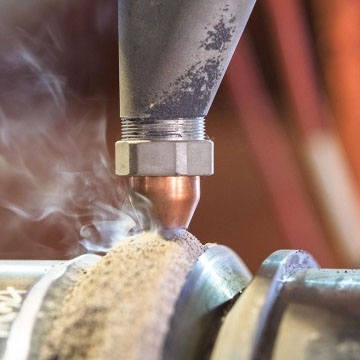
Welding flux for the SAW process is a granular, fusible material with a complex chemical composition. Beyond its chemistry, its physical form—specifically the size and distribution of its particles—is a critical characteristic. This is often referred to as the Basic Size Index (BSI) or simply as grain size, typically defined by a mesh size range (e.g., 12x48, 20x200). This range indicates that a majority of the particles will pass through the larger mesh screen (e.g., 12 openings per inch) but be retained by the smaller one (e.g., 48 openings per inch).
This distribution is not arbitrary. It directly influences several key aspects of the welding process:
- Current Carrying Capacity: This is one of the most significant factors. Generally, coarser flux particles (larger grains, smaller mesh number) are required for high-current applications. The larger voids between particles allow welding gases generated during the process to escape more easily, preventing arc blow and porosity. Finer fluxes, if used at excessively high currents, can trap these gases, leading to an unstable arc and weld defects.
- Arc Stability and Voltage: Finer flux particles tend to melt more readily and create a more conductive slag bath, which helps stabilize the arc, especially at lower current levels. This can be beneficial for achieving precise control and a smooth bead appearance. The flux's sizing directly impacts the ideal operating voltage for a stable arc.
- Flux Feeding and Consumption: The flowability of the flux through the delivery system is governed by its particle size. While very fine powders can be difficult to feed consistently, a well-graded, medium-sized flux generally flows smoothly. Grain size also affects the height and width of the flux burden required to properly cover the arc, which in turn influences the overall consumption rate.
- Slag Detachability: The cooling rate of the molten slag, which is influenced by the heat input and the thermal properties of the flux, affects how easily it can be removed after welding. The particle size distribution plays a role in the packing density of the flux burden, which can alter the cooling profile and, consequently, slag release.
At Oldwelders, we control these physical properties with precision. Our raw materials, including high-quality dolomite, bauxite, and silica, are melted at 2000 °C and then carefully crushed and screened to meet exacting size specifications. This ensures that every bag of flux delivers predictable and repeatable performance.
Aligning Flux Granularity with Specific Weld Joint Configurations
The primary goal when selecting a flux grain size is to ensure the flux can properly fill the joint, cover the arc completely, and perform its metallurgical and shielding functions without interfering with the process. Different joint geometries present unique challenges that can be addressed by choosing the correct particle distribution.
Narrow Groove and Deep V-Joints
For joints with a narrow gap or a deep, V-shaped preparation, such as those found in thick-walled pressure vessels or heavy structural components, a finer grain size is often preferred. The smaller particles can flow more easily into the tight confines of the joint root, ensuring complete coverage. Using a coarse flux in this scenario could lead to "bridging," where the larger particles get stuck at the top of the joint, leaving the root unprotected. This can result in an unstable arc, lack of fusion, and porosity at the most critical point of the weld.
Furthermore, the lower current typically used for root passes in these joints is more compatible with the arc-stabilizing characteristics of a finer flux. A typical size for these applications might be a 20x150 mesh flux. It's crucial to pair this with the right equipment, and a robust welding machine capable of precise parameter control is essential for success in deep groove welding.
Wide V-Grooves, Butt Joints, and Cladding
When welding wider butt joints or performing overlay cladding, higher deposition rates are often the primary objective. These applications utilize higher currents and travel speeds. In this context, a medium to coarse grain flux (e.g., 10x48 mesh) is the superior choice. The larger particles provide the necessary gas permeability to handle the high amperage without arc instability or porosity. The flux burden created by coarser grains is more resistant to being blown away by the force of the arc at high currents.
This allows welders to maximize productivity without sacrificing quality. The improved gas release ensures a sound weld deposit, which is critical for structural integrity. The choice of welding wire, such as a high-quality flux-cored wire or solid wire, must also be matched to the high-current application and flux type to achieve the desired mechanical properties and deposition rates.
Fillet Welds and Lap Joints
Fillet welds, particularly in the horizontal position, present a different challenge. The flux must be able to create a stable shelf that holds the molten weld pool in place against gravity. A medium-sized, well-graded flux often provides the best balance. It has sufficient flowability to cover the joint area but enough particle size variation to pack densely and form a supportive burden. A flux that is too coarse may not conform well to the joint's sharp angle, while a flux that is too fine might flow away from the weld area excessively. The correct flux helps shape the weld bead, ensuring a proper fillet profile and preventing undercut.
Operational Considerations: Flux Recycling and Moisture Control
Beyond the initial selection, the management of submerged arc flux during production is vital for maintaining weld quality. Many operations employ flux recovery systems to reduce waste and control costs. However, this process can alter the grain size distribution over time.
Managing Fines in Recycled Flux
During the SAW process, some flux particles are melted, while others are crushed by mechanical handling and recovery systems (e.g., vacuums). This leads to an accumulation of "fines"—very small particles—in the recycled flux. An excessive concentration of fines can drastically change the flux's performance. It can restrict gas escape, leading to porosity, and alter the voltage-current relationship, demanding adjustments from the operator. It can also increase the risk of slag inclusions as the fine, glassy particles may not float out of the weld pool effectively.
It is best practice to incorporate a screening system that removes excessive fines and to regularly add a percentage of new, virgin flux to the hopper. This helps maintain the original grain size distribution and ensures the welding procedure remains stable and repeatable. The ideal ratio of new to recycled flux should be determined through rigorous testing and qualification.
Moisture Absorption and Storage
All welding fluxes are hygroscopic to some degree, meaning they will absorb moisture from the atmosphere. Moisture is a source of hydrogen, which is the leading cause of hydrogen-induced cracking, a catastrophic weld defect. The total surface area of the flux particles influences the rate of moisture pickup; finer fluxes, with their higher collective surface area, can absorb moisture more quickly than coarser ones. Regardless of grain size, proper storage in a dry, climate-controlled environment is non-negotiable. If flux is exposed to humidity, it must be re-baked according to the manufacturer's specifications—typically at temperatures between 250-400°C—to drive off any absorbed moisture before use.
Partnering with a Reliable Flux Manufacturer
Choosing the correct submerged arc flux is a technical decision that directly impacts your productivity, quality, and profitability. The consistency of the flux, both in its chemical composition and its physical grain size, is paramount. Inconsistent sizing from bag to bag can force operators to constantly adjust parameters, leading to downtime and an increased risk of defects.
As a global supplier with established partners in Malaysia and across Southeast Asia, we understand the demands of large-scale industrial fabrication. Our 1000 square meter facility, equipped with six production lines, has a capacity to supply 100 tons of high-quality welding fluxes per day, ensuring a reliable supply chain for even the most ambitious projects. With a minimum order quantity of just 1 ton and a typical lead time of 30 days, we provide both the scale and flexibility our clients need. Our commitment to quality is validated by our ISO 9001 certification, guaranteeing that every batch of flux meets the stringent specifications required for critical applications. By starting with superior raw materials and employing a meticulous manufacturing process, we deliver a product you can trust to perform consistently, weld after weld.