
Selecting the Right Welding Electrode for Your Application
Selecting the Right Welding Electrode for Your Application
Choosing the correct welding electrode is a critical decision that directly impacts the quality, strength, and integrity of a final weld. For procurement managers and welding operators, navigating the vast array of available options can be challenging. The selection process goes beyond simply matching the base metal; it requires a detailed understanding of two fundamental factors: the welding position and the power source polarity. Making an informed choice ensures operational efficiency, minimizes rework, and upholds the structural standards required in demanding industrial applications. An incorrect choice can lead to poor penetration, excessive spatter, slag inclusions, and ultimately, a compromised weld that fails to meet specifications.
This guide provides a comprehensive overview of how to select the appropriate consumable by analyzing welding positions and polarity. By understanding the principles behind the American Welding Society (AWS) classification system and how different flux coatings behave under various electrical currents and gravitational forces, your team can standardize its selection process, improve weld quality, and optimize project outcomes. Whether working in a fabrication shop or on a remote construction site, these principles are universal and essential for success.
Understanding Welding Positions: The Foundation of Selection
Welding position refers to the orientation of the weld axis relative to the horizontal plane. Gravity is the primary force that welders must contend with, as it directly influences the behavior of the molten weld pool and the flow of slag. The AWS has standardized these positions using a number-and-letter system to create a universal language for fabrication blueprints and welder qualifications. The four primary positions for fillet and groove welds are the foundation for electrode selection.
1. Flat Position (1F / 1G)
The flat position is the easiest and most efficient position to weld in. The workpiece is positioned so that gravity pulls the molten metal and slag down into the joint. This allows for the use of higher amperages and larger diameter electrodes, resulting in higher deposition rates and faster travel speeds. Because the weld pool is easy to control, electrodes designed for this position often have a high iron powder content in their flux coating (e.g., E7024, E7028), which contributes to a very high deposition rate. Slag control is less of a concern, so the flux can be designed for maximum efficiency.
2. Horizontal Position (2F / 2G)
In the horizontal position, the weld axis is roughly horizontal. For a fillet weld (2F), the weld is made on the upper side of a horizontal surface against a vertical surface. For a groove weld (2G), the weld is made on a vertical surface. Gravity becomes a more significant factor here, as it can cause the molten puddle to sag. Welders must use specific techniques, such as maintaining a shorter arc and a slight upward angle, to counteract this effect. The choice of welding electrode becomes more critical; electrodes must have a faster-freezing slag that solidifies quickly to hold the molten metal in the joint. While some high-deposition electrodes can be used, those designed for all-position welding are often preferred for better puddle control.
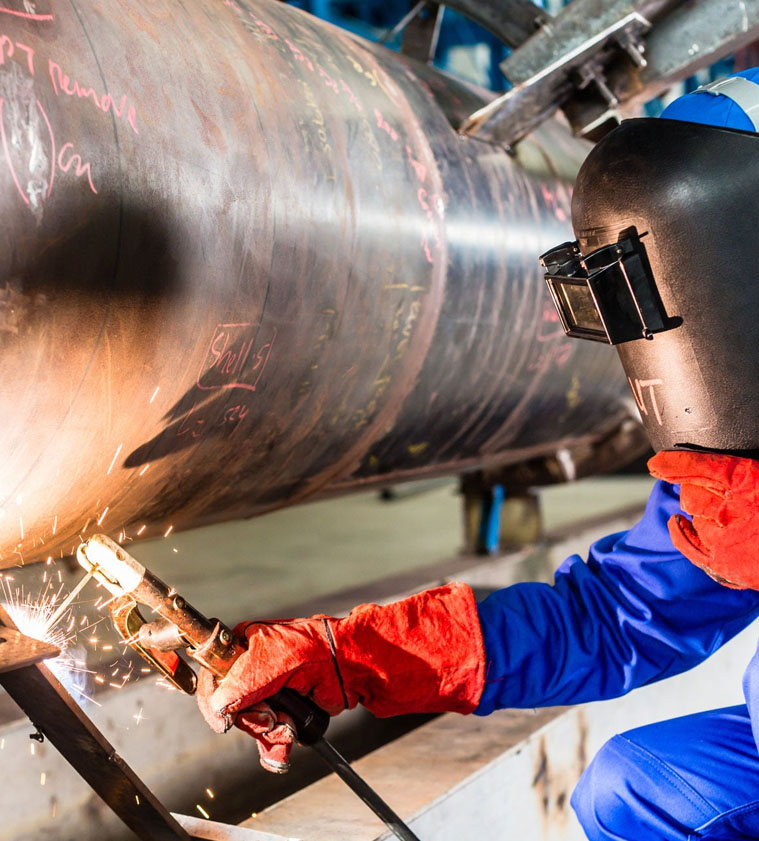
3. Vertical Position (3F / 3G)
The vertical position is significantly more challenging because the welder must fight gravity directly. The weld can be performed in an upward (uphill) or downward (downhill) progression.
- Vertical Up (Uphill): This technique is used for thicker materials as it allows for deeper penetration. The welder creates a small shelf of solidified weld metal to support the molten puddle. The electrode's flux coating must produce a fast-freezing slag that solidifies almost instantly to hold the weld metal in place. Electrodes like E6010 and E7018 are excellent for this, as their slag systems are designed for out-of-position work.
- Vertical Down (Downhill): This technique is faster but provides shallower penetration, making it suitable for thinner materials or sheet metal. It requires a fast travel speed and an electrode with aggressive arc characteristics, such as the E6010, to stay ahead of the molten puddle.
4. Overhead Position (4F / 4G)
The overhead position is the most difficult and requires the highest level of operator skill. The welder is working underneath the workpiece, and gravity is constantly trying to pull the molten metal out of the joint. Only specific electrodes, often referred to as "all-position" electrodes, are suitable for this work. These consumables must have a very fast-freezing slag and a strong, forceful arc to ensure the molten metal transfers into the joint and does not fall. Electrodes such as E6010, E6011, and E7018 are standard choices for overhead welding due to their superior puddle control and slag systems designed explicitly for out-of-position applications.
The Critical Role of Polarity in Arc Welding
Polarity refers to the direction of current flow in the welding circuit. It is a function of the welding power source and has a profound effect on arc characteristics, heat distribution, penetration profile, and overall weld quality. The three options are Direct Current Electrode Negative (DCEN), Direct Current Electrode Positive (DCEP), and Alternating Current (AC).
Direct Current Electrode Negative (DCEN / Straight Polarity)
In DCEN, the electrode is connected to the negative terminal and the workpiece to the positive terminal. Electrons flow from the electrode to the workpiece. This configuration concentrates approximately two-thirds of the arc's heat on the workpiece.
- Characteristics: Higher deposition rate (melts the electrode faster), shallower penetration.
- Applications: Best suited for welding thin materials where burn-through is a risk or when a fast deposition rate is needed for build-up work on hard-surfacing applications.
Direct Current Electrode Positive (DCEP / Reverse Polarity)
In DCEP, the electrode is connected to the positive terminal and the workpiece to the negative. This reverses the flow of electrons, concentrating about two-thirds of the arc's heat on the electrode.
- Characteristics: Deeper, more penetrating arc; lower deposition rate compared to DCEN. The arc also has a cleaning action that helps remove oxides from the base metal surface, resulting in a higher quality weld.
- Applications: Ideal for thicker materials requiring deep penetration and for all-position welding, especially vertical up and overhead. Most common all-position electrodes, like E6010 and E7018, are designed to run on DCEP.
Alternating Current (AC)
AC polarity means the current rapidly switches between negative and positive, typically 50 or 60 times per second (50/60 Hz). The heat is distributed more evenly between the electrode and the workpiece.
- Characteristics: Less arc blow (magnetic deflection of the arc), moderate penetration between DCEN and DCEP. AC is often used with budget-friendly power sources.
- Applications: Suitable for general-purpose fabrication. Many electrodes have an "AC" designation in their recommended currents (e.g., E7018-AC or E6013), indicating they are designed with arc stabilizers in the flux to maintain a stable arc as the current passes through zero. When working with a variety of materials and joint types, a versatile arc welding machine with selectable polarities is essential.
Matching Electrode Characteristics to Position and Polarity
The AWS classification system for shielded metal arc welding (SMAW) electrodes provides all the necessary information on the consumable itself. For a common carbon steel electrode like E7018, the numbering breaks down as follows:
- E: Indicates it is an electrode.
- 70: Indicates the minimum tensile strength in thousands of pounds per square inch (psi), so 70,000 psi.
- 1: Indicates the usable welding positions. (1 = All positions; 2 = Flat and horizontal only; 4 = All positions, but specifically for vertical down).
- 8: This digit indicates the type of flux coating, its operating characteristics, and the required polarity.
This is where position and polarity come together. The last two digits are key. For example:
- E6010: The '1' indicates all-position capability. The '0' indicates a cellulosic flux that produces a deep, penetrating arc, designed exclusively for DCEP. This is the go-to rod for pipe welding roots, especially in vertical and overhead positions.
- E7018: The '1' indicates all-position use. The '8' signifies a low-hydrogen, iron powder flux. It runs best on DCEP but can also be used with AC. It produces high-quality, crack-resistant welds and has a smoother arc than an E6010, making it a versatile choice for structural steel. A specific product like the aws e6013 welding electrodes is another popular all-position choice known for its user-friendly arc on AC or DC polarities.
- E7024: The '2' indicates it is restricted to flat and horizontal positions only. The '4' specifies a high iron powder rutile flux, designed for very high deposition rates. It is not suitable for vertical or overhead work as the fluid slag and large molten puddle would be uncontrollable.
How Flux Coating Influences Performance
The flux coating on a welding electrode is far more than just a protective layer. It is a complex mixture of minerals and chemicals that determines the electrode's performance. As a manufacturer with a 1000 square meter plant and six production lines, we understand the science behind these formulations. Our process begins with excellent raw materials like dolomite, bauxite, and silica, which are melted at 2000 °C to create our high-performance welding fluxes. This precision manufacturing, governed by our ISO 9001 certified quality management system, ensures every rod performs as expected.
The flux composition dictates:
- Slag Viscosity and Freezing Rate: For out-of-position welding, the slag must be thick and fast-freezing to create a shelf that holds the molten metal. For flat position welding, a more fluid slag is acceptable and can provide better wetting action.
- Arc Stabilizers: Elements like potassium are added to help maintain a stable arc, especially on AC power sources.
- Gas Shielding: The flux decomposes in the arc to create a gaseous shield (primarily carbon dioxide) that protects the molten weld pool from atmospheric contamination like oxygen and nitrogen.
- Deoxidizers: Elements like silicon and manganese are included to cleanse the weld metal, removing impurities and preventing porosity.
- Alloying Elements: For specialty electrodes, elements like chromium, nickel, or molybdenum are added to the flux to give the final weld specific mechanical properties.
Practical Considerations for Procurement and Operations
For procurement teams and operational managers, making the right welding electrode choice has bottom-line implications. Standardizing on the correct electrodes for your most common applications reduces inventory complexity and ensures welders always have the right tool for the job. Partnering with a reliable supplier is paramount. With a production capacity of 100 tons a day, we are equipped to handle large-scale orders for clients in markets from Brazil and Thailand to Australia and Malaysia.
Consider the following when ordering:
- Project Requirements: Are your projects primarily structural steel in a shop (flat/horizontal) or field pipe welding (all positions)? Align your primary electrode inventory with your most common tasks.
- Welder Skill Level: Some electrodes, like the E7018, are more user-friendly than others, like the E6010, which requires a higher skill level to manage its forceful arc.
- Power Source Availability: Ensure the electrodes you purchase are compatible with your fleet of welding machines (AC, DC, or both).
- Supplier Capacity and Lead Time: For large projects, you need a supplier who can deliver consistently. We offer a standard lead time of 30 days and a minimum order quantity (MOQ) of 1 ton, catering specifically to B2B industrial needs.
In conclusion, the selection of a welding electrode is a technical decision that should be driven by a clear understanding of welding position and polarity. By interpreting the AWS classification and appreciating the role of the flux coating, your team can ensure every weld is performed efficiently, safely, and to the highest quality standards. This foundational knowledge empowers both the welder at the arc and the manager in the office to make choices that enhance productivity and ensure structural integrity.