
HJ431 Flux: Compare Quotes by Usable Weld Metal Cost
How to Accurately Compare HJ431 Flux Quotes for Maximum Value
For procurement managers and welding engineers sourcing bulk welding consumables, evaluating quotes for materials like HJ431 Flux can seem straightforward. The common approach is to compare the price per kilogram or per ton. However, this method often overlooks critical performance variables that determine the true cost of your welding operations. A lower initial purchase price can easily lead to higher overall expenses through increased material consumption, rework, and labor time. The most accurate way to assess a supplier's offer is by calculating the usable weld metal cost—a figure that reflects the real-world efficiency and performance of the product.
Focusing on this comprehensive metric allows you to move beyond surface-level pricing and identify a supplier who delivers not just a product, but genuine operational value. It requires a deeper understanding of how the flux interacts with your welding wire and base metal under specific parameters. This guide will provide a detailed framework for evaluating quotes, enabling you to make a financially sound decision that enhances weld quality, boosts productivity, and optimizes your budget.
Beyond the Price Tag: Understanding True Weld Metal Cost
The ex-works price of a welding flux is only one component of its total cost. The true cost is revealed during application. Two batches of HJ431 Flux from different suppliers might have a 10% price difference, but the more expensive option could be 20% more efficient, resulting in significant net savings. This efficiency is measured by how much flux is consumed to deposit a specific amount of weld metal.
Key performance indicators directly impact this calculation. These include the flux consumption ratio, deposition rate and efficiency, slag detachability, and the final weld bead appearance. A high-quality flux excels in these areas, minimizing waste and reducing the need for post-weld cleaning and repairs. When you request a quote, you are not just buying a bag of granular material; you are investing in a specific level of performance. As a manufacturer with a robust production capacity of 100 tons per day, we understand that consistency in this performance is paramount for large-scale industrial projects.
By shifting your evaluation from "cost per ton" to "cost per meter of quality weld," you align your procurement strategy with your production goals. This approach protects your operations from the hidden costs of inferior materials and provides a reliable basis for comparing suppliers. It transforms the purchasing decision from a simple price comparison into a strategic assessment of long-term value and operational efficiency.
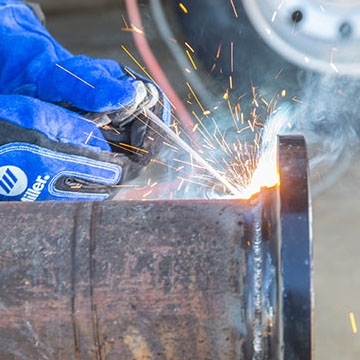
Key Factors Influencing Usable Weld Metal Cost
To accurately calculate the usable weld metal cost, you must analyze several technical performance factors. These metrics reveal the true efficiency of the flux in your specific application. When evaluating samples from potential suppliers, focus on quantifying the following aspects.
1. Flux Consumption Ratio (FCR)
The Flux Consumption Ratio is arguably the most critical factor. It is the ratio of the weight of flux consumed to the weight of weld wire melted during the welding process. A lower FCR is always better, as it means you use less flux to deposit the same amount of metal, leading to direct material cost savings.
Formula: FCR = Weight of Flux Consumed / Weight of Wire Melted
For submerged arc welding (SAW), the FCR for a particular HJ431 Flux typically ranges from 0.9 to 1.2. This means that for every 1 kg of wire melted, 0.9 to 1.2 kg of flux is consumed. A flux with an FCR of 0.95 is more cost-effective than one with an FCR of 1.1, even if the latter has a slightly lower initial purchase price. The difference becomes substantial when purchasing in multi-ton quantities.
The FCR is influenced by:
- Basicity Index: The chemical composition of the flux. Our process, which involves melting premium raw materials like dolomite, bauxite, and silica at 2000°C, is precisely controlled to achieve an optimal basicity index for stable performance.
- Particle Size Distribution: Consistent granulation ensures a stable arc and uniform melting, contributing to a lower, more predictable FCR. Inconsistent particle sizes can lead to arc instability and higher consumption.
- Welding Parameters: Voltage, current, and travel speed all affect how much flux is melted. It's crucial to test samples using your standard production parameters to get an accurate FCR measurement.
2. Deposition Rate and Efficiency
Deposition rate is the weight of weld metal deposited per unit of time (e.g., kg/hour). Deposition efficiency is the ratio of the weight of the weld metal deposited to the weight of the electrode wire consumed. While largely dependent on the welding wire and parameters, the flux plays a crucial role in stabilizing the arc to achieve these rates efficiently.
A high-quality HJ431 Flux facilitates a stable, concentrated arc, which allows for higher welding currents and travel speeds without sacrificing quality. This directly increases the deposition rate, improving overall productivity. An unstable arc, often caused by inconsistent flux composition, can lead to spatter and an erratic weld pool, reducing deposition efficiency and wasting expensive welding wire. When evaluating suppliers, consider their ability to maintain batch-to-batch consistency—a core principle of our ISO 9001 certified quality management system.
3. Slag Detachability
After welding, the molten flux cools to form a protective layer of slag over the weld bead. The ease with which this slag can be removed is a major factor in labor costs and overall productivity. Excellent slag detachability means the slag lifts away easily, often "self-peeling" as it cools, or requiring only a light tap with a chipping hammer.
Poor slag detachability, on the other hand, requires intensive manual labor, such as grinding or chipping, to remove. This not only dramatically increases the time spent on each weldment but also introduces the risk of damaging the weld surface. The costs associated with this extra labor can quickly negate any savings from a cheaper flux. During sample testing, pay close attention to the post-weld cleaning effort required. This is a direct indicator of the flux's quality and its impact on your bottom line.
4. Weld Bead Appearance and Porosity
The final quality of the weld is paramount. A superior flux produces a smooth, uniform weld bead with excellent tie-in at the toes of the weld, free from defects like porosity, cracking, or undercut. A poor-quality flux can introduce impurities into the weld pool, leading to porosity. Porosity is a critical defect that can compromise the structural integrity of the weld, often requiring the entire section to be gouged out and re-welded.
The cost of rework is exceptionally high. It involves not only the labor to remove the defective weld and re-weld it but also the wasted materials (wire, flux, gas) and the significant production delays. A reliable HJ431 Flux ensures a clean and deoxidized weld pool, minimizing the risk of such defects and guaranteeing the mechanical properties of the joint. This reliability is a cornerstone of our product, trusted by clients in demanding industrial markets from Brazil to Australia.
Calculating Your Total Cost of Welding with HJ431 Flux
With an understanding of the key performance factors, you can now construct a formula to compare quotes based on total operational cost. This requires data from testing samples provided by potential suppliers.
Step 1: Gather Your Data
- Supplier A Quote: Price per kg of Flux (P_A)
- Supplier B Quote: Price per kg of Flux (P_B)
- Your Welding Wire Cost: Price per kg of Wire (P_W)
- Test Result for Supplier A: Flux Consumption Ratio (FCR_A)
- Test Result for Supplier B: Flux Consumption Ratio (FCR_B)
Step 2: Calculate the Consumable Cost to Deposit 1 kg of Weld Metal
Assuming a deposition efficiency of nearly 100% for simplicity (in reality, you would use your measured efficiency), you will need approximately 1 kg of wire to produce 1 kg of weld metal.
The amount of flux needed is determined by the FCR.
- Cost for Supplier A: (1 kg Wire * P_W) + (1 kg Wire * FCR_A * P_A)
- Cost for Supplier B: (1 kg Wire * P_W) + (1 kg Wire * FCR_B * P_B)
Example Calculation: Let's assume:
- Welding Wire Cost (P_W) = $2.00/kg
- Supplier A Flux Price (P_A) = $1.10/kg
- Supplier B Flux Price (P_B) = $1.00/kg (10% cheaper)
- Supplier A Test Result (FCR_A) = 0.95
- Supplier B Test Result (FCR_B) = 1.15
Cost Calculation for Supplier A: (1 * $2.00) + (1 * 0.95 * $1.10) = $2.00 + $1.045 = $3.045 per kg of weld metal
Cost Calculation for Supplier B: (1 * $2.00) + (1 * 1.15 * $1.00) = $2.00 + $1.15 = $3.15 per kg of weld metal
In this realistic scenario, the initially cheaper flux from Supplier B results in a higher total consumable cost per kilogram of deposited weld metal. This simple calculation demonstrates why looking beyond the sticker price is essential. It doesn't even account for the additional potential costs from poor slag removal or rework, which would further favor the higher-quality product from Supplier A.
Why Consistent Quality from a Reliable Supplier Matters
The calculation above highlights the importance of performance, and performance is a direct result of manufacturing quality and consistency. When selecting a supplier for a critical consumable like HJ431 Flux, their production capabilities and quality control processes are as important as the product's technical specifications.
At Oldwelders, we operate a 1000-square-meter facility with six production lines, ensuring we can meet demanding supply schedules with a minimum order quantity of just 1 ton and a typical lead time of 30 days. Our commitment to quality is validated by our ISO 9001 certification. We ensure every batch of our welding fluxes meets stringent standards for chemical composition, particle size distribution, and moisture content. This dedication to quality control guarantees that the performance you see in a test sample is the same performance you will get in every bag, pallet, and container load.
This reliability is why we have become a trusted partner for industrial clients in diverse markets, including Thailand and Malaysia. They depend on our products for consistent results in critical applications. When you partner with a manufacturer that prioritizes quality, you are not just buying a product; you are securing a stable and predictable production process. This stability minimizes unexpected downtime, reduces rework rates, and ultimately protects your profitability. Our comprehensive range of welding materials and equipment, including a variety of welding machine models, is all built on this same foundation of quality and reliability.
A Practical Checklist for Evaluating Supplier Quotes
To streamline your procurement process and ensure you make the most cost-effective decision, use this checklist when comparing quotes for welding flux.
- Request More Than Just Price: Ask for a full technical data sheet (TDS) for the HJ431 Flux. This should include chemical composition, basicity index, and typical mechanical properties of the weld metal.
- Always Test a Sample: Never make a decision based on a data sheet alone. Request a sample and conduct a welding procedure qualification test using your own equipment, parameters, and welders.
- Measure the Flux Consumption Ratio (FCR): This is the most important metric. Carefully weigh the flux and wire before and after a test weld to calculate the FCR accurately.
- Evaluate Slag Detachability: Observe and record the effort required to remove the slag. Involve your welders and supervisors in this evaluation, as they can provide valuable real-world feedback.
- Inspect the Weld Bead: Conduct visual and, if necessary, non-destructive testing (NDT) to check for surface quality, uniformity, and internal defects like porosity.
- Calculate the True Weld Metal Cost: Use the formula provided above with your test data and the quoted prices to determine the actual cost per kilogram of deposited metal.
- Assess Supplier Reliability: Inquire about the supplier's quality control systems (e.g., ISO 9001 certification), production capacity, lead times, and experience in supplying to international markets. A reliable supply chain is critical for avoiding production stoppages.
By following this structured approach, you can confidently select an HJ431 Flux supplier that offers the best overall value, ensuring high-quality welds, efficient production, and a healthier bottom line for your business.