
Welding Flux Selection Fused vs Agglomerated
Choosing the Right Welding Flux for Industrial Applications
In the world of high-deposition, heavy fabrication, the success of a Submerged Arc Welding (SAW) procedure hinges on numerous variables. While the power source and wire selection are critical, the granular material that gives the process its name—the welding flux—is the unsung hero. It dictates everything from arc stability and bead appearance to the final weld metal's mechanical properties. For welding engineers and procurement managers, a primary decision point is the choice between two major manufacturing types: fused and agglomerated. Understanding the fundamental differences between them is essential for optimizing weld quality, productivity, and cost-effectiveness.
This guide provides a detailed B2B comparison to help you specify the correct flux for your application, whether you are fabricating pressure vessels, structural steel, wind towers, or heavy-duty pipelines. The right selection ensures procedural compliance, reduces rework, and enhances the integrity of your final product.
The Fundamental Role of Flux in Submerged Arc Welding
Before comparing manufacturing methods, it's crucial to understand what SAW flux does. During the welding process, the flux is fed from a hopper to the joint, completely covering the arc. This blanket of granular material performs several critical functions simultaneously:
- Shielding: As the flux melts under the heat of the arc, it forms a protective layer of molten slag that shields the weld pool from atmospheric contaminants like oxygen and nitrogen. This prevents porosity and embrittlement, ensuring a sound weld.
- Arc Stabilization: The chemical composition of the flux contains arc stabilizers that help maintain a consistent, focused, and smooth-running arc, which is essential for uniform penetration and bead shape.
- Deoxidation and Cleaning: The flux contains deoxidizing agents (such as manganese and silicon) that react with impurities like oxides and scale on the base metal, cleansing the weld pool and floating these impurities to the surface to be trapped in the slag.
- Alloying: Certain types of flux can be formulated to add specific alloying elements to the weld metal. This allows for precise control over the final mechanical properties of the weld, such as tensile strength, impact toughness, and hardness.
- Bead Shaping and Slag Release: The viscosity and freezing point of the molten slag shape the final weld bead. After cooling, the solidified slag should be easy to remove, a property known as slag detachability, which is crucial for welder productivity.
The method used to manufacture the flux—fusing or agglomerating—directly impacts how well it performs these functions and determines its suitability for different applications.
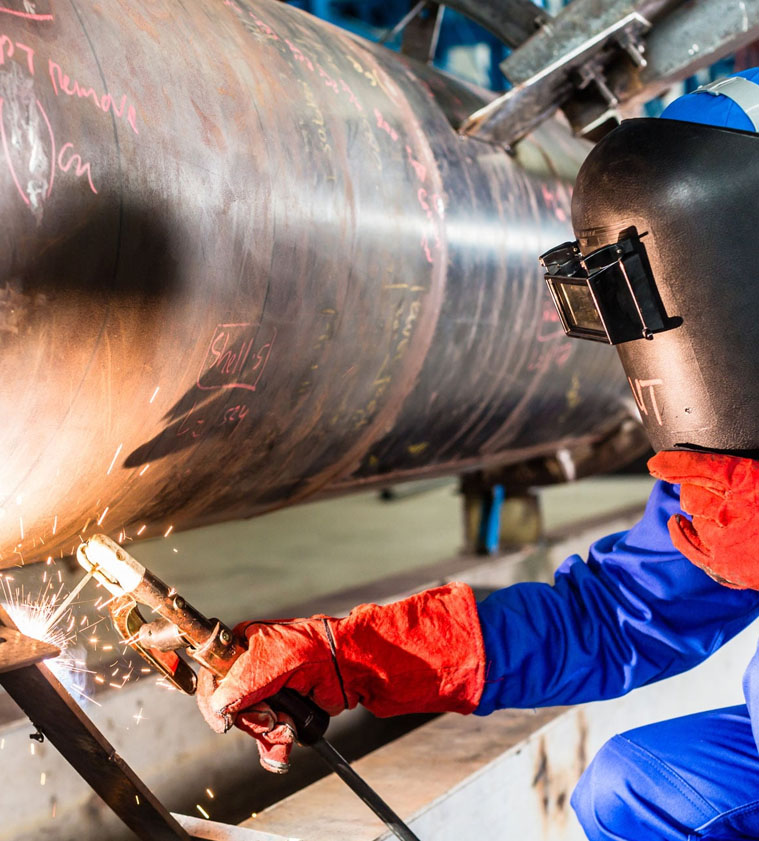
Fused Welding Flux: Consistency Under High Amperage
Fused flux is produced through a high-temperature melting and vitrification process. At Oldwelders, we manufacture our fused fluxes by melting a precise combination of raw materials, such as high-purity dolomite, bauxite, cryolite, and silica, in an electric furnace at temperatures reaching 2000 °C. This molten mixture is then cooled and crushed into a hard, glassy, and chemically homogeneous granular material.
Characteristics and Advantages
The high-temperature manufacturing process gives fused flux a distinct set of properties:
- Chemical Homogeneity: Because all ingredients are melted together into a uniform glass-like substance, each grain of flux has the exact same chemical composition. This eliminates the risk of segregation and ensures absolute consistency from one weld to the next.
- Non-Hygroscopic: The glassy, non-porous nature of fused flux means it does not readily absorb moisture from the atmosphere. This reduces the need for special storage or pre-weld baking procedures, simplifying handling and minimizing the risk of hydrogen-induced cracking.
- High Current Capacity: Fused fluxes are generally more stable at very high welding currents, making them an excellent choice for high-productivity applications like multi-wire SAW on thick plate.
- Excellent Recyclability: Due to its uniform composition and durability, unfused flux can be collected by a vacuum system, sieved, and mixed with new flux without significantly altering the chemical balance of the welding process.
Limitations
Despite its advantages, fused flux has limitations. The high-temperature production process makes it difficult and often impossible to add certain deoxidizers and alloying elements, as they would vaporize or react prematurely. This limits the ability to fine-tune weld metal chemistry through the flux alone. Therefore, achieving specific mechanical properties often relies more heavily on the choice of welding wire.
Agglomerated Welding Flux: Versatility and Alloying Potential
Agglomerated flux, also known as bonded flux, is manufactured through a completely different, lower-temperature process. It involves dry-mixing finely powdered raw minerals, deoxidizers, ferroalloys, and other chemical components. This dry mix is then combined with a liquid binder, typically a silicate solution (like potassium or sodium silicate), to form a wet mass. This mass is pelletized and then baked in an oven at a much lower temperature (typically 400-600 °C) to remove moisture and cure the binder.
Characteristics and Advantages
This "baking" process preserves the individual components, leading to a different set of performance traits:
- High Versatility: The low-temperature process allows for the inclusion of a wide range of deoxidizers, metallic powders, and ferroalloys. This makes agglomerated fluxes highly versatile for controlling the final weld metal chemistry and achieving specific mechanical properties, such as high impact toughness at low temperatures, which is critical in offshore and structural applications.
- Excellent Slag Detachability: Agglomerated fluxes can be formulated to provide superior slag release, which is a significant advantage in multi-pass welds, reducing inter-pass cleaning time and improving overall productivity.
- Lower Amperage Suitability: They generally provide a softer, more stable arc at lower currents compared to many fused fluxes, making them suitable for welding thinner materials or performing root passes. A specific example is our popular submerged arc welding flux hj431, known for its stable performance.
Limitations
The primary drawback of agglomerated flux is its hygroscopic nature. The porous structure and binder can absorb atmospheric moisture, which can introduce hydrogen into the weld pool if not properly managed. This necessitates controlled storage in low-humidity environments and, often, re-baking the flux in a rod oven before use according to the manufacturer's specifications. Additionally, the powdered components can be subject to segregation during transport and handling, which requires careful quality control during manufacturing.
Key Decision Criteria: Fused vs. Agglomerated
Choosing between fused and agglomerated flux requires a thorough analysis of your project's specific requirements. Consider the following factors:
1. Required Mechanical Properties
If your application demands stringent mechanical properties, particularly high impact toughness at low temperatures (e.g., Charpy V-notch testing), an agglomerated flux is often the superior choice. Its ability to carry alloying elements provides the control needed to meet demanding specifications for industries like offshore, pressure vessel, and bridge construction.
2. Welding Parameters and Productivity
For high-speed, high-current, single-pass welding on thick steel plates, a fused flux is often preferred. Its stability under high energy input ensures a consistent, deep-penetrating weld. Its recyclability also adds to its cost-effectiveness in high-volume production environments.
3. Base Material Condition and Type
Agglomerated fluxes typically offer a higher "basicity index," which relates to their ability to clean and deoxidize the weld pool. This makes them more tolerant of rust or mill scale on the base material. Fused fluxes, while effective, generally perform best on clean, well-prepared surfaces.
4. Handling and Storage Environment
If your workshop or field environment has high humidity or lacks dedicated, temperature-controlled storage, a fused flux's non-hygroscopic nature offers a significant operational advantage. It reduces the risk of hydrogen-related defects and simplifies inventory management. Conversely, if you have robust handling procedures, including rod ovens for re-baking, then agglomerated flux is a perfectly viable option.
5. Multi-Pass vs. Single-Pass Welding
For complex joints requiring multiple weld passes, the superior slag detachability of many agglomerated fluxes can significantly reduce cleaning time between passes, boosting overall welder efficiency. This is a critical consideration in calculating the total cost of welding.
Partner with a Manufacturer Committed to Quality
The performance of any flux, whether fused or agglomerated, is ultimately determined by the quality of its manufacturing. At Oldwelders, we operate under a strict ISO 9001 certified quality management system. Our 1000-square-meter facility is equipped with six modern production lines, capable of supplying up to 100 tons of high-purity welding consumables per day. This capacity ensures we can reliably serve large-scale projects for our partners in demanding markets like Brazil, Thailand, Australia, and Malaysia.
Our commitment to quality starts with the raw materials. We source excellent dolomite, bauxite, cryolite, and other ores to ensure the final product is free from impurities that could compromise weld integrity. With a minimum order quantity of 1 ton and a standard lead time of 30 days, we are structured to support the planning and execution needs of serious B2B clients. Whether you need a standard flux or a custom formulation, our technical team can help you select the ideal product for your application. We offer a comprehensive range of welding materials to complement our fluxes, ensuring a complete solution for your fabrication needs.
In summary, the "fused vs. agglomerated" decision is not about which is better, but which is right for the job. Fused flux offers robustness and consistency for high-current applications, while agglomerated flux provides the chemical versatility needed for achieving specific, demanding mechanical properties. By carefully evaluating your application's needs and partnering with a knowledgeable manufacturer, you can ensure every weld meets the highest standards of quality and performance. Explore our range of welding machine solutions to find the perfect equipment for your SAW process.