
Reduce Shipyard Welding Rework With Fit-Up Control
Reduce Shipyard Welding Rework With Effective Fit-Up Control
In the demanding world of marine fabrication, rework is more than an inconvenience; it is a significant drain on resources, schedules, and profitability. The process of grinding out a defective weld, re-preparing the joint, and re-welding consumes valuable labor hours, delays project milestones, and can compromise the structural integrity of critical assemblies. For quality assurance managers and fabrication foremen, minimizing these repair rates is a primary objective. While many factors contribute to weld quality, one of the most critical and often overlooked is pre-weld fit-up. Implementing rigorous fit-up control is the single most effective proactive measure to reduce rework in shipyard welding.
This article moves beyond general welding practices to provide a focused guide for production and quality teams. We will explore the direct link between joint fit-up and common weld defects, outline key inspection points for a robust fit-up control program, and discuss how high-quality consumables can provide a crucial buffer against minor inconsistencies.
The High Cost of Rework in Shipyard Welding
The cost of a weld is not merely the price of labor and consumables during the initial deposition. The true cost includes inspection, and most significantly, the exponential expense of any required repairs. In a shipyard environment, this is amplified due to the scale of the components, difficult access, and stringent regulatory requirements.
Consider the typical rework cycle:
- Defect Identification: Non-destructive testing (NDT) like ultrasonic or radiographic testing identifies a flaw. This process itself has an associated cost and time.
- Removal: The defective section must be removed, usually by carbon arc gouging or grinding. This is a slow, labor-intensive process that introduces noise, fumes, and potential for damage to the surrounding base metal.
- Re-preparation: The excavated area must be ground smooth and re-beveled to the original joint specification, requiring skilled labor and careful measurement.
- Pre-heating: Depending on the material thickness and specification, the area may need to be pre-heated again.
- Re-welding: The joint is re-welded, often under less-than-ideal conditions compared to the initial fabrication.
- Re-inspection: The repaired area must undergo NDT again to ensure the defect has been successfully removed and the new weld is sound.
This entire cycle can cost 5 to 15 times more than making the weld correctly the first time. When multiplied across hundreds or thousands of meters of weld in a single vessel, the financial impact is staggering. Beyond direct costs, rework introduces schedule uncertainty, creates production bottlenecks, and negatively impacts team morale. Effective fit-up control is not an added expense; it is a direct investment in first-pass quality and overall project efficiency.
What is Weld Fit-Up and Why It Matters
Weld fit-up refers to the manner in which components are aligned and prepared before welding begins. It encompasses the dimensional accuracy of the joint geometry—specifically the gap, alignment, and angles. While a skilled welder can sometimes compensate for poor fit-up, this reliance on individual skill introduces variability and risk. A consistent, well-controlled fit-up sets the foundation for a repeatable, high-quality welding process, regardless of which operator is performing the work.
Poor fit-up is a primary root cause of many common and critical weld defects:
- Lack of Fusion/Penetration: If the root gap is too tight or inconsistent, the welding arc cannot reach the root of the joint, leading to an incomplete weld that is a major structural concern.
- Burn-Through: Conversely, if the root gap is excessively wide, the molten weld pool can fall through the joint, particularly on root passes. This requires stopping, grinding, and often re-welding from the opposite side.
- Weld Reinforcement Issues: An inconsistent gap can lead to either excessive reinforcement (requiring costly grinding) or underfill (a structural defect).
- Distortion and Angular Misalignment: Poor fit-up forces the welder to deposit more filler metal on one side of the joint, creating unbalanced thermal stresses that can warp and distort large panels and sub-assemblies.
- Cracking: Excessive gaps can increase residual stress in the completed weld, raising the risk of both fabrication cracking and in-service fatigue cracking.
By controlling these geometric variables before an arc is ever struck, fabrication teams can eliminate the root cause of a significant percentage of all weld defects encountered in shipyard welding.
Key Pre-Weld Inspection Points for Fit-Up Control
A successful fit-up control program is built on clear standards and systematic inspection. Foremen and QA inspectors should be equipped with the right tools (such as bridge-cam and hi-lo gauges) and a clear checklist of what to verify before authorizing welding to commence.
Root Gap Consistency
The root gap is the space between the members at the bottom of the joint. It is arguably the most critical fit-up dimension. The gap must be wide enough to allow for full penetration but not so wide as to cause burn-through. The key is consistency along the entire length of the seam. A 3mm gap that varies to 1mm or 5mm is far more problematic than a consistent 4mm gap. Tacking should be used strategically to hold the gap dimension constant during welding.
Plate Alignment and Mismatch (Hi-Lo)
Hi-lo refers to the misalignment of the plates, where one surface is higher or lower than the other. This condition makes it difficult to produce a sound weld and creates a stress concentration point at the joint. Most shipbuilding standards limit hi-lo to 1-2mm, depending on plate thickness. It must be checked and corrected using clamps, dogs and wedges, or hydraulic jacking before welding the root pass.
Bevel Angle and Root Face
The angle of the bevel and the size of the root face (the small flat portion at the bottom of the bevel) are specified in the Welding Procedure Specification (WPS). Incorrect angles affect the volume of the joint, which in turn impacts the amount of filler metal required, the heat input, and the potential for distortion. Inspectors should spot-check these dimensions, especially after manual grinding or automated cutting processes, to ensure they are within the tolerances set by the WPS.
Cleanliness and Surface Preparation
While not a dimensional aspect, cleanliness is an inseparable part of fit-up. The joint and adjacent surfaces must be completely free of mill scale, rust, paint, oil, moisture, and any other contaminants. These substances introduce hydrogen and other impurities into the weld pool, which is a primary cause of porosity and hydrogen-induced cracking. A final visual inspection for cleanliness just before welding is a simple but vital step.
The Role of Quality Consumables in Mitigating Fit-Up Challenges
Even with the best fit-up controls, the realities of large-scale fabrication mean that minor variations will occur. This is where the quality and formulation of your welding consumables become critical. Premium consumables provide a wider operating window, helping the welder produce a sound weld even in slightly imperfect conditions. At Oldwelders, we understand the unique demands of shipyard welding and have engineered our products to deliver superior performance and consistency.
Our commitment to quality is validated by our ISO 9001 certification, ensuring that every product adheres to the highest international standards. In our 1000-square-meter facility, six dedicated production lines can supply up to 100 tons of product per day, guaranteeing a reliable supply chain for large-scale projects. This capacity allows us to serve major shipbuilding markets, including our partners in Brazil, Thailand, Australia, and Malaysia.
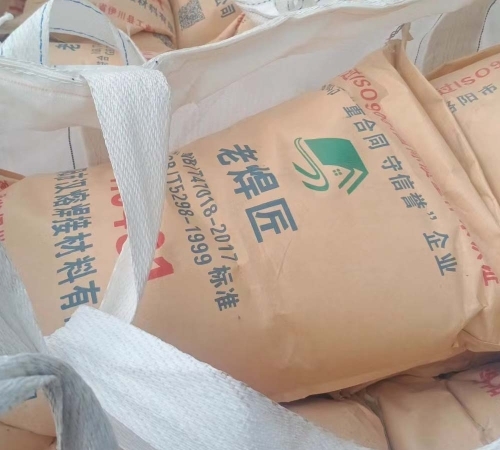
The performance of our welding fluxes, for example, begins with the raw materials. We use excellent dolomite, bauxite, and silica, which are melted at 2000 °C to ensure purity and create a flux with a stable, protective slag. A well-formulated flux like our submerged arc welding flux hj431 offers excellent slag detachability and a smooth bead appearance, which helps bridge inconsistent gaps and reduces post-weld cleaning time. Similarly, our welding wires are manufactured with tight control over chemical composition and diameter, resulting in a stable arc and predictable deposition rate.
While high-quality consumables are not a substitute for proper fit-up, they act as an essential safety net. Choosing a reliable supplier with a proven track record and robust quality control systems provides fabrication teams with the confidence that their welding machine is loaded with a product designed for the application, reducing a key variable in the complex equation of weld quality.
Conclusion: Shifting from Reactive Repair to Proactive Control
Reducing rework in shipyard welding requires a fundamental shift in mindset: from relying on the welder's skill to fix problems, to empowering the entire fabrication team to prevent them. By implementing a systematic program of pre-weld fit-up control, focusing on root gap, alignment, and cleanliness, shipyards can dramatically reduce the incidence of common defects. This proactive approach not only lowers the staggering direct and indirect costs of repair but also leads to more predictable production schedules, higher overall quality, and a safer final product.
Pairing this disciplined process with high-performance, certified welding consumables creates a robust system for achieving first-pass quality. By focusing on controlling the variables before the arc is struck, you pave the way for more efficient, profitable, and reliable marine construction.