
Match Sintered Flux Basicity to SAW Steel Grades
How to Select the Right Sintered Flux Basicity for Your Steel Grade
In submerged arc welding (SAW), achieving the required mechanical properties, weld integrity, and productivity hinges on the careful selection of consumables. While the welding wire provides the bulk of the filler metal, the flux plays a multifaceted role in shielding the arc, refining the weld metal, and shaping the final bead. For fabrication teams working on critical projects, understanding how to match the basicity of a Sintered Flux to the specific steel grade is not just a technical detail—it is fundamental to success. This choice directly influences weld metal chemistry, toughness, and resistance to cracking.
Choosing incorrectly can lead to failed qualification tests, costly rework, or even in-service failures. This guide provides a clear framework for selecting the appropriate flux basicity for your carbon, low-alloy, and high-strength steel applications, ensuring you meet demanding project specifications from the start.
Understanding Basicity and Its Effect on Weld Metal
Before selecting a flux, it is crucial to understand what "basicity" means and how it impacts the final weld. The Basicity Index (BI) is a calculated ratio that compares the concentration of basic oxides (like CaO, MgO, BaO, Na₂O) to acidic oxides (like SiO₂, TiO₂) in the flux formulation. This chemical balance dictates the flux's metallurgical behavior during welding.
At Oldwelders, we manufacture our flux products by melting premium raw materials, including dolomite, bauxite, and silica, at temperatures reaching 2000 °C. This meticulous, high-temperature process allows us to precisely control the chemical composition and, therefore, the Basicity Index of each batch.
Key Metallurgical Functions of Flux Basicity:
- Oxygen Control: Highly basic fluxes have a lower oxygen potential. This results in cleaner weld metal with fewer non-metallic inclusions, such as silicates. A lower oxygen content is directly correlated with improved notch toughness, a critical requirement for applications in cold climates or those subject to dynamic loading.
- Desulfurization and Dephosphorization: Basic slags are more effective at removing impurities like sulfur and phosphorus from the molten weld pool. High levels of these elements can lead to hot cracking, so their removal by a basic flux is essential when welding steels with higher impurity levels or for critical service applications.
- Alloy Transfer: The flux’s basicity influences the transfer of alloying elements like manganese (Mn) and silicon (Si) into the weld. Acidic fluxes tend to promote the transfer of silicon and burn off manganese, while basic fluxes do the opposite. This must be accounted for when pairing a flux with a specific wire to achieve the target weld metal chemistry.
In short, a higher Basicity Index generally leads to cleaner, tougher weld metal, while a lower Basicity Index often provides better operational characteristics, such as easier slag removal and a smoother bead profile.
Matching Flux Basicity to Common Steel Grades
The primary driver for selecting a flux basicity level is the mechanical property requirements of the base material and the welding procedure specification (WPS). The following provides a general guideline for matching flux types to different categories of steel.
Low Basicity (Acidic & Neutral Fluxes, BI < 1.2)
Acidic and neutral fluxes are characterized by their high silica and titania content. They offer excellent operational benefits that make them ideal for high-productivity environments.
- Typical Applications: General structural steel (e.g., ASTM A36), single-pass fillet welds, and applications where impact toughness is not the primary design consideration.
- Advantages: These fluxes provide a very smooth bead finish, excellent slag detachability (often self-peeling), high deposition rates, and good resistance to porosity on lightly rusted or scaled plate. Their stable arc is well-suited for high-speed, automated welding.
- Limitations: The resulting weld metal has a higher oxygen content and, consequently, lower impact toughness compared to welds made with basic fluxes. They are generally not recommended for high-strength, quenched and tempered, or critical structural steels.
Medium Basicity (Semi-Basic & Basic Fluxes, BI 1.2 - 2.0)
This category represents a versatile compromise, offering a good balance between mechanical properties and welder-friendly operation. It is one of the most widely used ranges for demanding fabrication work.
- Typical Applications: Pressure vessel fabrication (e.g., SA-516), pipeline construction, bridge building, and multi-pass welding on medium-strength structural steels.
- Advantages: They produce weld metal with good to excellent impact toughness, suitable for many code-compliant applications. Slag removal is typically manageable, and they offer a good deposition rate. This type of Sintered Flux is a reliable choice for a wide range of automatic welding machine setups.
- Limitations: While providing solid mechanical properties, they may not meet the extreme low-temperature toughness requirements achievable with highly basic fluxes.
High Basicity (Highly Basic Fluxes, BI > 2.0)
When the highest level of weld metal purity and toughness is required, highly basic fluxes are the definitive choice. Their chemistry is engineered to produce the cleanest possible weld deposit.
- Typical Applications: Offshore structures, shipbuilding, nuclear components, heavy-walled pressure vessels, and welding high-strength low-alloy (HSLA) steels. These are the fluxes of choice for applications requiring excellent Charpy V-notch (CVN) toughness at sub-zero temperatures.
- Advantages: Produces exceptionally clean weld metal with very low levels of oxygen, sulfur, and hydrogen. This results in superior resistance to cracking and the best possible impact toughness.
- Limitations: The operational characteristics can be more challenging. The slag is often more adherent and difficult to remove, especially in narrow groove joints. The bead profile may be more convex, and they are more susceptible to moisture absorption, requiring strict adherence to storage and handling procedures (e.g., baking).
The Sintered Flux Advantage in Manufacturing and Performance
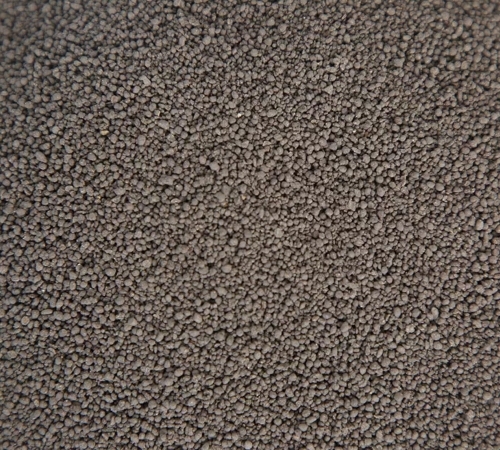
Fluxes for SAW are typically produced by one of two methods: fused or agglomerated (which includes sintered). A Sintered Flux is created by mixing finely ground mineral powders with a binder, pelletizing them, and then baking them at a high temperature, but below their melting point. This process offers distinct advantages.
The sintering method allows for the easy addition of deoxidizers and alloying elements directly into the flux. This provides a mechanism for fine-tuning the weld metal chemistry to achieve specific properties, which is more difficult with fused fluxes. This manufacturing flexibility is critical for developing fluxes tailored to modern, high-performance steels. As an ISO 9001 certified company, our rigorous production controls ensure that every batch of flux delivers consistent chemistry and predictable performance, a necessity for clients in demanding markets like Brazil and Australia who rely on repeatable welding procedures.
Practical Considerations for Flux Selection and Handling
Beyond basicity, several other factors must be considered to ensure a successful welding operation.
Current Type and Amperage
The flux’s formulation affects its ability to support different current types (AC/DC) and levels. Acidic fluxes generally have a higher current-carrying capacity and perform well with AC for high-speed welding. Basic fluxes may have limitations on amperage to maintain arc stability and prevent overheating of the slag. Always consult the manufacturer's datasheet for recommended operating parameters.
Slag Detachability
In multi-pass welding, easy slag removal is a major driver of productivity. While highly basic fluxes offer superior metallurgy, the time spent on deslagging can impact project timelines. For applications with many short welds or complex joints, a flux with easier slag removal (often in the medium-basicity range) may be a more practical choice, provided it meets the required mechanical properties. For a complete list of our available welding materials, you can review our catalog to find the optimal balance for your needs.
Moisture Control
Basic fluxes are generally more hygroscopic (prone to absorbing moisture) than acidic fluxes. Moisture in the flux is a primary source of diffusible hydrogen in the weld metal, which can lead to hydrogen-induced cracking, especially in thick or high-strength steels. It is imperative to store and handle basic fluxes according to manufacturer recommendations, which often include storage in a heated environment and re-baking in a rod oven before use.
Your Partner for High-Performance Welding Consumables
Selecting the right Sintered Flux is a critical decision that impacts weld quality, productivity, and project profitability. At Oldwelders, we leverage our deep expertise in material science and welding metallurgy to provide consumables that meet the world's most demanding standards. Our state-of-the-art plant, covering 1000 square meters with six production lines, has a capacity of 100 tons per day, ensuring a reliable supply chain for large-scale projects in markets from Thailand to Malaysia.
With a standard lead time of 30 days and a minimum order quantity of just 1 ton, we are equipped to be your flexible and dependable partner. Whether you are fabricating structural steel, pressure vessels, or critical offshore components, our team can help you select the ideal flux and wire combination. We invite you to explore our comprehensive range of welding fluxes or contact us to discuss the specific technical requirements of your next project.