
How Pressure Vessel Welding Meets ASME Code Requirements
How Pressure Vessel Welding Achieves Compliance with ASME Code
For fabrication engineers and quality managers, ensuring the integrity and safety of high-pressure equipment is paramount. The fabrication of boilers, reactors, and storage tanks involves stringent processes where a single faulty weld can lead to catastrophic failure. This is why pressure vessel welding is governed by a comprehensive set of rules known as the ASME Boiler and Pressure Vessel Code (BPVC). Meeting these standards is not merely a suggestion; it is a mandatory requirement for legal operation and, most importantly, for ensuring safety. Understanding how welding procedures, welder qualifications, and material choices align with these codes is the foundation of successful and compliant fabrication.
This guide provides a practical overview for technical professionals, clarifying the relationship between key compliance documents and the critical role of high-quality consumables and equipment. By adhering to these principles, manufacturers can produce vessels that are safe, reliable, and fully compliant with international standards.
Understanding the ASME Boiler and Pressure Vessel Code (BPVC)
The American Society of Mechanical Engineers (ASME) Boiler and Pressure Vessel Code (BPVC) is the leading standard for the design, fabrication, inspection, and testing of boilers and pressure vessels. Its primary purpose is to ensure the safety of life and property by establishing rules of construction and in-service inspection. The code is divided into several sections, with Section IX, "Welding, Brazing, and Fusing Qualifications," being the most critical for welding operations.
ASME Section IX does not provide "how-to" instructions for welding. Instead, it establishes the requirements for qualifying the procedures and the personnel involved in the welding process. The core philosophy is that if a standardized test weld proves to be mechanically sound, then subsequent production welds performed under the same documented conditions by a qualified welder will also be sound. This principle of qualification and documentation is fundamental to ensuring repeatability, traceability, and quality in all fabrication activities. Compliance is not a one-time event but a continuous process of documentation, testing, and verification that extends from raw material procurement to final inspection.
The Three Pillars of ASME Welding Compliance: WPS, PQR, and WPQ
To meet ASME Section IX requirements, fabrication shops must create and maintain a system of three interrelated documents. These documents form a "compliance map" that proves both the process and the personnel are fit for purpose. Top-performing competitors in markets from Brazil to Australia rely on this robust documentation to guarantee quality.
1. Welding Procedure Specification (WPS)
A Welding Procedure Specification (WPS) is a formal, written document that provides detailed instructions to the welder for making production welds. Often called the "recipe" for the weld, it contains all the essential, nonessential, and supplementary essential variables required to produce a sound joint. These variables include:
- Joint Design: The geometry of the joint (e.g., V-groove, U-groove) and details on root opening and groove angle.
- Base Metals: The P-Number and Group-Number classification of the materials being joined.
- Filler Metals: The F-Number and A-Number of the welding consumable, along with its specific classification (e.g., AWS A5.17).
- Welding Process: The specific process used, such as Submerged Arc Welding (SAW) or Gas Tungsten Arc Welding (GTAW).
- Positions: The welding positions (e.g., 1G, 2G, 6G) for which the procedure is qualified.
- Preheat and Post-Weld Heat Treatment (PWHT): Minimum preheat temperatures and the parameters for any required thermal stress relief.
- Electrical Characteristics: The amperage, voltage range, polarity, and travel speed.
- Technique: Details on stringer vs. weave beads, multi-pass vs. single-pass, and methods for back-gouging.
The WPS must be available to the welder and quality inspectors. Its purpose is to ensure consistency and repeatability in every weld produced under its scope.
2. Procedure Qualification Record (PQR)
The Procedure Qualification Record (PQR) is the documented evidence that the WPS can produce a mechanically sound weld. It is the "proof" that the recipe works. To create a PQR, a test coupon is welded according to the parameters laid out in a draft WPS. This test weld is then subjected to a series of destructive and non-destructive tests as specified by ASME Section IX. These tests typically include:
- Visual Inspection (VT): To check for surface discontinuities.
- Radiographic (RT) or Ultrasonic Testing (UT): To identify internal flaws.
- Mechanical Testing: Including tensile tests (to measure strength) and bend tests (to measure ductility and soundness).
The PQR documents the exact values and observations recorded during the test weld, including the actual amperage, voltage, travel speed, and all other essential variables. It also contains the official results from the laboratory tests. Once the PQR is certified, it serves as the permanent supporting document for one or more WPSs. A WPS cannot be used for production without a corresponding PQR to validate it.
3. Welder Performance Qualification (WPQ)
While the PQR qualifies the procedure, the Welder Performance Qualification (WPQ) qualifies the person. The WPQ is the record that proves a specific welder has the necessary skill to produce a sound weld by following a qualified WPS. To become qualified, a welder must perform a test weld under the observation of a supervisor or inspector. This test weld is then evaluated, typically through visual inspection and bend tests (or radiography for certain processes).
The WPQ documents the essential variables under which the welder was tested, such as the welding process, filler metal type, position, and thickness range. A welder's qualification is specific to these variables. For example, a welder qualified for a 1G (flat) position is not automatically qualified to weld in a 6G (all-position) orientation. The WPQ records are maintained by the employer and must be kept current, as qualifications can expire if the welder does not use the specific process for a period of six months or more.
Key Welding Processes for Pressure Vessels
The choice of welding process is critical in the fabrication of pressure vessels, dictated by material thickness, joint design, and production efficiency requirements. Each process offers distinct advantages for specific applications.
Submerged Arc Welding (SAW)
SAW is a high-deposition, automated or semi-automated process ideal for long, straight seams and circumferential welds on thick-walled vessels. In this process, the arc is "submerged" under a blanket of granular flux, which protects the molten weld pool from atmospheric contamination. This results in high-quality, deep-penetrating welds with excellent mechanical properties and a smooth finish. The process is highly efficient and minimizes welder exposure to arc flash and fumes. For optimal results, a high-quality flux like submerged arc welding flux hj431 is essential to ensure proper slag detachability and weld bead appearance.
Gas Tungsten Arc Welding (GTAW / TIG)
GTAW, or TIG welding, is a precision process used for critical applications, especially root passes and welding on thinner materials or corrosion-resistant alloys. It uses a non-consumable tungsten electrode and a separate filler wire, giving the welder exceptional control over the weld pool. The resulting welds are extremely clean, strong, and of high aesthetic quality. While slower than other processes, GTAW is often specified for the root pass on thick vessels to ensure a flawless, full-penetration joint before filling the remaining groove with a higher-deposition process like SAW or GMAW.
Shielded Metal Arc Welding (SMAW)
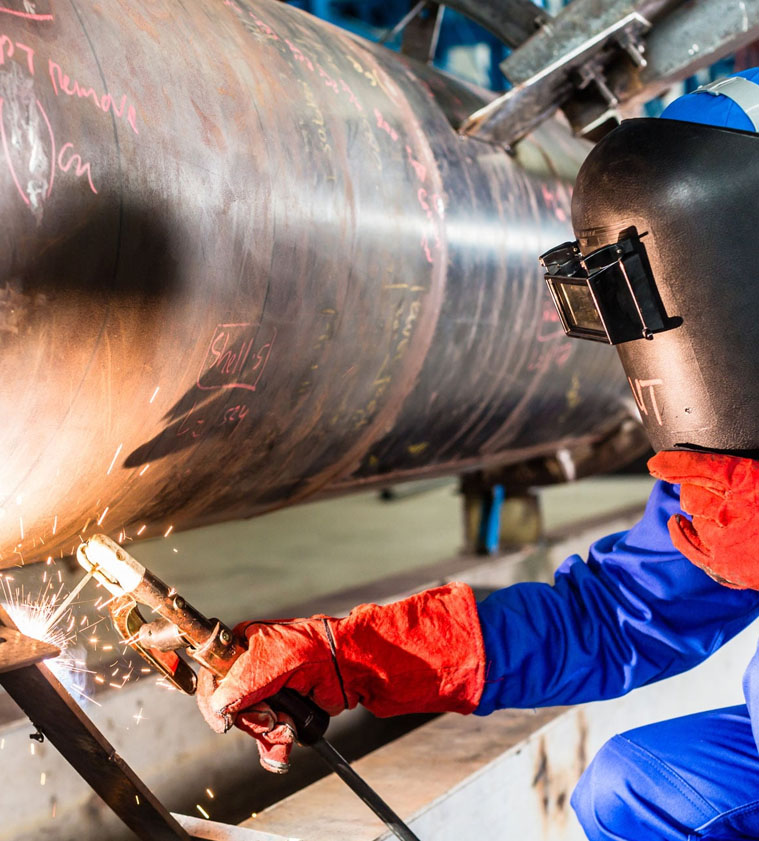
SMAW, also known as stick welding, is a versatile and widely used manual process. It is valued for its simplicity, portability, and effectiveness in various positions and environments. In pressure vessel fabrication, SMAW is often used for repairs, tack welding, and welding in locations where it is impractical to use semi-automated equipment. The choice of electrode is critical, as its flux coating provides the shielding gas, deoxidizers, and slag cover needed to protect the weld.
The Critical Role of Welding Consumables
No matter how well-defined the procedure or how skilled the welder, the final quality of a weld is directly dependent on the quality of the consumables used. Filler metals and fluxes are not just filler material; they are engineered products that contribute to the chemical composition and mechanical properties of the finished weld. For pressure vessel fabrication, consumables must meet strict AWS and ASME specifications.
Choosing a supplier with a robust quality management system is essential. As an ISO 9001 certified company, we understand the importance of traceability and consistency. Our manufacturing plant, covering 1000 square meters with six production lines, can produce 100 tons of welding fluxes per day. The raw materials—including high-grade dolomite, bauxite, and cryolite—are melted at 2000 °C to create homogenous, high-purity products that deliver reliable performance in critical applications. This commitment to quality ensures that every batch of welding wire, rod, or flux meets the stringent requirements for code-compliant fabrication.
Partnering for Compliant and Efficient Fabrication
Achieving and maintaining ASME compliance for pressure vessel welding is a complex but manageable process. It requires a deep understanding of the code, meticulous documentation (WPS, PQR, WPQ), and a commitment to using qualified personnel, proven processes, and high-quality materials.
For procurement and quality managers in markets like Thailand and Malaysia, partnering with a reliable supplier is a strategic advantage. A capable partner can provide not just the materials but also the technical support and documentation needed to streamline your qualification process. With a standard lead time of 30 days and a minimum order quantity of 1 ton, Oldwelders is equipped to support large-scale fabrication projects with certified and reliable consumables. By integrating a trusted supplier into your quality chain, you can focus on what you do best: building safe, high-performance pressure vessels that meet the world's most demanding standards. Explore our range of welding machine solutions and consumables to support your next project.