
Understanding Sintered Flux in Submerged Arc Welding
Understanding Sintered Flux for Optimal Submerged Arc Welding Performance
Submerged Arc Welding (SAW) is a high-productivity welding process widely utilized across various heavy industries, from shipbuilding to pressure vessel fabrication. A critical component in achieving high-quality, consistent welds in SAW is the welding flux. Among the different types of fluxes available, welding fluxes, specifically Sintered Flux, stands out due to its unique manufacturing process and resulting performance characteristics. For welding engineers and fabrication buyers, understanding the intricacies of sintered flux is essential for making informed material selections that impact weld quality, efficiency, and cost.
At Oldwelders, we provide a comprehensive range of welding materials, including specialized fluxes designed to meet the rigorous demands of industrial applications. Our commitment to quality is underscored by our ISO 9001 certification, ensuring that every product, including our advanced fluxes, meets stringent international standards. With a plant covering an area of 1000 square meters and housing six production lines, we possess the capability to supply up to 100 tons of flux daily, ensuring consistent availability for projects of all scales. Our minimum order quantity for fluxes is typically 1 ton, with a lead time of approximately 30 days, designed to support your operational schedules in markets such as Brazil, Thailand, Australia, and Malaysia.
The Manufacturing Process of Sintered Flux
The distinction of sintered flux begins with its unique manufacturing method, which imparts specific metallurgical and physical properties. Unlike fused fluxes, which are melted and then crushed, or bonded fluxes, which use a binder, sintered flux involves a controlled heating process that creates a homogenous product with distinct advantages.
Raw Material Selection and Preparation
The journey of high-quality sintered flux starts with the careful selection of raw materials. At Oldwelders, we utilize excellent dolomite, bauxite, cryolite, silica, fluorine ore, and other essential ores. These raw materials are meticulously sourced and prepared to ensure purity and consistency, forming the foundation for superior flux performance. The precise combination of these materials is crucial for dictating the chemical composition of the final flux, which in turn influences the metallurgical reactions during welding.
Granulation and Mixing
Once selected, the raw materials are finely ground into a powder form. These powders are then precisely weighed and thoroughly mixed in specific proportions. This mixing process ensures a uniform distribution of all components, which is vital for achieving consistent weld properties. Water glass or other silicate binders are often added during this stage to facilitate granulation.
Pelletization and Drying
The mixed powder, along with the binder, is then formed into small pellets or granules. This can be achieved through various methods, such as pan granulation or extrusion. These green (unfired) pellets are then dried to remove moisture, preparing them for the crucial sintering stage.
Sintering: The Defining Step
The dried pellets are then subjected to a high-temperature sintering process, typically in a rotary kiln or furnace. Unlike fused fluxes that are melted at very high temperatures (around 2000 °C, similar to how we melt our raw materials for other flux products), sintered flux is heated to temperatures generally below its melting point, usually between 800 °C and 1200 °C. This controlled heating causes the particles to bond together through solid-state diffusion, forming a porous, granular structure. This process is carefully controlled to prevent complete melting, preserving the unique properties of the constituent materials while achieving a stable, homogenous structure.
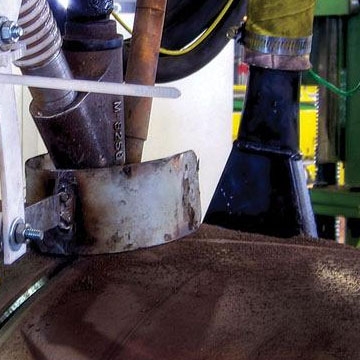
Crushing, Screening, and Packaging
After sintering, the resulting clinker is crushed to the desired particle size. It then undergoes screening to ensure a consistent grain size distribution, removing fines and oversized particles. Finally, the finished sintered flux is packaged, often in moisture-resistant bags, to maintain its quality until use. This entire process, from raw material selection to final packaging, is precisely controlled in our facilities to ensure that every batch of submerged arc welding flux HJ431, and other variants, meets our high standards.
Key Characteristics and Benefits of Sintered Flux
The sintering process imparts several distinct characteristics to this type of flux, offering significant advantages in specific welding applications.
Homogeneous Composition and Consistency
One of the primary benefits of sintered flux is its highly homogeneous composition. The controlled heating and solid-state bonding ensure that all elements are uniformly distributed throughout each granule. This translates to consistent metallurgical reactions during welding, leading to uniform weld metal chemistry and mechanical properties. Such consistency is paramount for critical applications where predictable weld performance is non-negotiable.
Good Alloying Capability
Sintered fluxes are known for their excellent alloying capabilities. During the welding process, alloying elements can be incorporated into the flux and then transferred to the weld pool, allowing for precise control over weld metal chemistry. This enables the production of high-strength, tough, or corrosion-resistant weld deposits, depending on the specific application requirements. This capability makes sintered flux particularly valuable for joining specialized alloys or for achieving specific metallurgical outcomes.
Low Moisture Absorption
The manufacturing process often results in a flux with lower hygroscopicity compared to some other flux types. This means it has a reduced tendency to absorb moisture from the atmosphere. Low moisture content is crucial in SAW to prevent hydrogen-induced cracking (HIC) and porosity in the weld metal, which can compromise weld integrity. The reduced moisture absorption of sintered flux contributes to more robust and defect-free welds.
Good Slag Detachability and Bead Shape
Sintered fluxes are engineered to produce a slag that is typically easy to remove after cooling, improving post-weld cleaning efficiency. They also contribute to a smooth, uniform weld bead shape, which is aesthetically pleasing and often indicates good weld quality and penetration. These characteristics contribute to higher productivity and reduced rework, which are significant economic advantages for fabrication shops.
Recyclability and Environmental Considerations
Depending on the specific composition and application, some sintered fluxes can be recovered and reused, particularly the unfused portion. This offers potential economic and environmental benefits by reducing material waste. However, proper handling and separation of the fused slag from the unfused flux are essential for effective recycling.
Applications and Considerations for Sintered Flux
Given its unique properties, sintered flux finds extensive use in a variety of industrial sectors where quality and performance are critical. Understanding its applications and the factors influencing its selection is key for welding professionals.
Typical Applications
- Heavy Fabrication: Used in the fabrication of large structures such as bridges, offshore platforms, and heavy machinery, where high deposition rates and consistent weld quality are required.
- Pressure Vessels and Boilers: Essential for welding components of pressure vessels, boilers, and storage tanks, where weld integrity and mechanical properties are paramount for safety and longevity.
- Shipbuilding: Employed in the construction of ship hulls and other marine structures, demanding high-strength welds that can withstand harsh environments.
- Pipe Manufacturing: Integral to the production of large-diameter pipes for oil and gas pipelines, requiring robust and defect-free circumferential and longitudinal welds.
- Surfacing and Cladding: Due to its alloying capabilities, sintered flux is often chosen for surfacing applications to deposit wear-resistant or corrosion-resistant layers onto base metals.

Factors for Selection
Choosing the appropriate sintered flux involves considering several factors to match the flux to the specific welding application and desired weld properties:
- Base Material: The type of steel or alloy being welded significantly influences flux selection. Different fluxes are formulated for mild steel, low-alloy steels, stainless steels, and other specialized alloys.
- Welding Parameters: Welding current, voltage, travel speed, and electrode stick-out all interact with the flux to determine weld penetration, bead shape, and metallurgical characteristics.
- Desired Weld Properties: The required mechanical properties of the weld metal, such as tensile strength, yield strength, impact toughness, and corrosion resistance, are critical considerations. Sintered fluxes can be designed to enhance specific properties through alloying.
- Flux Basicity: The basicity index of the flux (acidic, neutral, or basic) affects its metallurgical behavior, including desulfurization, deoxidation, and hydrogen control. Basic fluxes generally offer better impact toughness and hydrogen control.
- Regulatory and Code Requirements: For many critical applications, specific welding codes and standards (e.g., AWS, ASME) dictate the types of fluxes and welding procedures that must be used.
- Economic Considerations: While performance is key, the cost-effectiveness, including deposition rates, slag removal efficiency, and potential for rework, also plays a role in the selection process.
Choosing the Right Sintered Flux for Your Needs
The selection of the correct sintered flux is a critical decision that directly impacts the quality, efficiency, and safety of your welding operations. At Oldwelders, we understand the complexities involved in this choice and are dedicated to providing solutions that meet your specific requirements. Our extensive range of arc welding machine and welding consumables, including various types of fluxes, is designed to support diverse industrial applications.
When evaluating options, consider the consistency and reliability offered by manufacturers. Our production capabilities, with six lines and a daily output of 100 tons, coupled with our ISO 9001 certification, ensure that you receive products of consistent quality. The raw materials used in our flux products, such as excellent dolomite, bauxite, cryolite, silica, and fluorine ore, melted at 2000 °C for some variants, underscore our commitment to material excellence.
Engaging with our technical experts can help you navigate the specifications and performance characteristics of different types of flux. We can assist in matching the right submerged arc welding flux HJ431 or other specialized fluxes to your base materials, welding processes, and desired weld properties. Whether you are welding mild steel, high-strength low-alloy steel, or stainless steel, our portfolio includes fluxes optimized for various metallurgical outcomes, from enhanced toughness to improved corrosion resistance.
In addition to our comprehensive range of fluxes, we also supply a wide array of welding machine, welding wire, and welding rods, providing a complete solution for your welding needs. Our goal is to be your trusted partner in achieving superior weld quality and operational efficiency. Contact Oldwelders today to discuss how our high-performance sintered flux and other welding consumables can enhance your fabrication processes and project outcomes.